

Nicholas Branigan | Non-ergodicity and Simpson’s paradox in neural correlates
Downloads an .ics file · Times are in America/Los_Angeles · Google Calendar
Abstract
What are the neural correlates of human behavior? Much research has approached versions of this question between individuals but not within individuals (over time). Are results from these 2 approaches similar? To address this, we mapped the neural correlates of 4 cognitive measures both between and within individuals in over 4000 people. We combined fMRI with a probabilistic model of the stop signal task that we developed to capture trial-level variation in cognitive measures. For each of these measures, neural correlates diverged between versus within individuals—a striking example of non-ergodicity and Simpson’s paradox. For example, individuals with worse control had less brain activity, but when an individual had worse control they had more brain activity. I’ll argue that non-ergodicity creates both challenges and opportunities for human neuroscience. Studies relying on individual-average measures have left unanswered fundamental questions about temporal dynamics. This means that our picture of the neural correlates of cognition and disease may be dramatically incomplete, but it also suggests that new discoveries could come from experiments and models that now target within-individual variation.
Bio
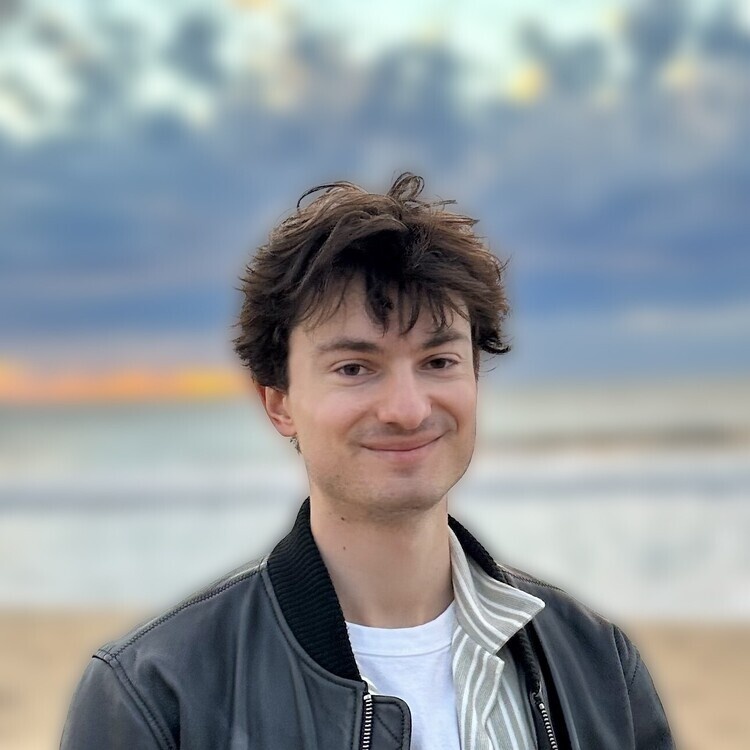
Nicholas is a Research Data Analyst at Stanford with Vinod Menon. He is interested in developing methods to understand large-scale behavioral and brain data. He has worked on developing probabilistic machine learning models, including drift-diffusion models of cognitive control and state-space models of fMRI and calcium imaging. Before falling for neuroscience, Nicholas worked in experimental economics with Muriel Niederle and philanthropic strategy with Paul Brest. He received an MS in statistics and a BA in economics, both from Stanford.
About the Center for Neural Data Science Seminar Series
The Center for Neural Data Science Seminar Series is a platform for trainees across campus to share insights and innovative approaches that bridge the gap between neuroscience and data science.
As neuroscience continues to generate vast amounts of data—from intricate neural circuit maps to large-scale brain activity recordings—the need for interdisciplinary expertise in data science, statistics, and engineering has never been more critical.
The Center for Neural Data Science mission is to advance brain research through the development of cutting-edge analytical methodologies and collaborative approaches. Stanford's affiliates are invited to join this vibrant community dedicated to transformative discoveries.
This seminar series is only offered in person.
Happy Hour/Reception for Attendees:
Seminars attendees are invited to stay for a happy hour reception after the seminar to continue the conversation with the speaker.
Sign up to learn about all our upcoming events
More like this near Palo Alto



Going to Nicholas Branigan? Ask me anything about it.
I read the organiser's pages and answer in a few seconds.
Answers are AI-generated · Privacy