

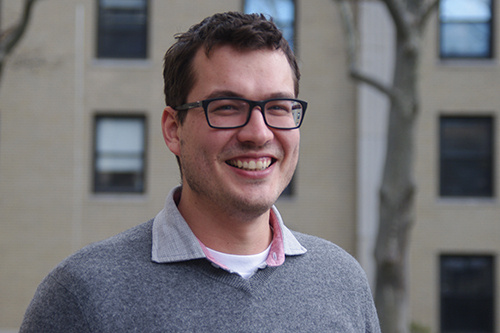
EAS Seminar: Matěj Pec (MIT)
Downloads an .ics file · Times are in America/New_York · Google Calendar
How do rocks fail? Quantifying the total energy budget of laboratory earthquakes
Fault zones accommodate relative motion between tectonic blocks and host earthquake ruptures. Understanding the mechanisms of abrupt failure and energy dissipation during rapid slip is essential for advancing earthquake physics. In this talk, I examine energy partitioning during laboratory earthquakes produced in general-shear, stick-slip experiments on synthetic granitic cataclasites under elevated confining pressure. Using ultrasonic monitoring, microstructural analysis, and novel magnetism-based local thermometry, we independently quantified the full energy budget of abrupt failure, including contributions from seismic wave radiation, surface creation, and heat dissipation.
Microstructural observations reveal the development of anastomosing principal slip zones composed of nanometric and amorphous materials prior to failure, which strongly influence energy partitioning during rapid slip. These ultrafine materials exhibit pronounced velocity-strengthening behavior that inhibits frictional instability. However, they are also an order of magnitude weaker than their microcrystalline counterparts and display a melting point depression of several hundred degrees, making them highly susceptible to thermal weakening. These findings highlight the critical role of grain size reduction and strain localization in earthquake nucleation—factors not fully captured by current models of the earthquake cycle.
Bio: Matěj Pec studies the mechanical and microstructural response of rocks to various driving forces associated with plate tectonic movements and human activity. To this end, he performs experiments in the laboratory and compares the results to natural observations and theoretical models. His lab specializes on designing novel experimental set-ups and developing probes for in-situ monitoring of deformation at high pressure and high temperature conditions. His work so far has focused on elucidating the processes occurring at the base of the seismogenic layer, across the brittle – ductile transition zone, and the influence of mineralization on physical and mechanical properties of rocks. He is particularly interested in the coupling between deformation and chemical reactions.
Matěj earned a M.Sc. in structural geology from the Charles University in Prague, Czech Republic and a Ph.D. in rock mechanics at the Universität Basel in Switzerland followed by a post-doctoral appointment at the University of Minnesota. Matěj joined the Department of Earth, Atmospheric and Planetary Sciences at the Massachusetts Institute of Technology in January 2017 as an assistant professor and was promoted to associate professor with tenure in 2026.
More like this near Ithaca





Going to EAS Seminar? Ask me anything about it.
I read the organiser's pages and answer in a few seconds.
Answers are AI-generated · Privacy