

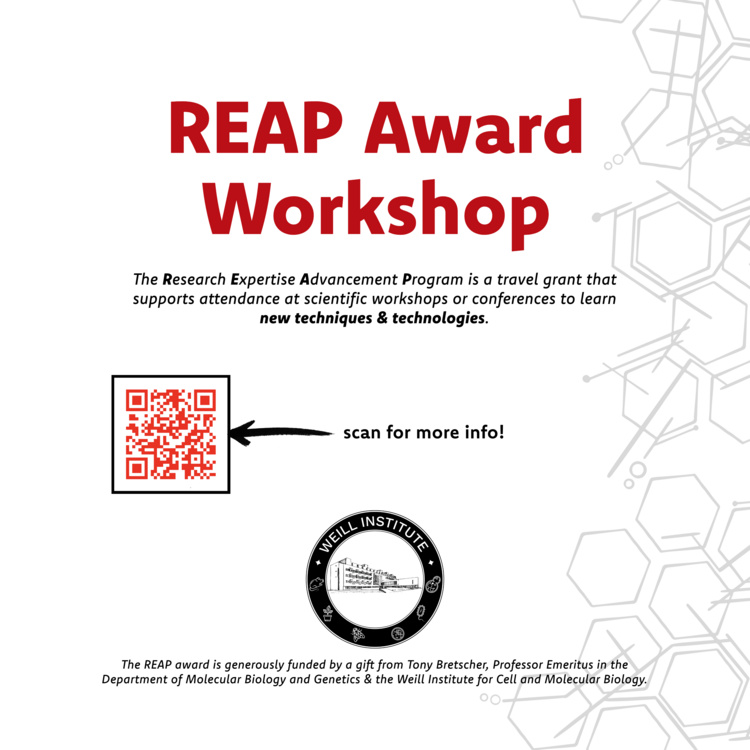
REAP Workshop Fall 2026
Downloads an .ics file · Times are in America/New_York · Google Calendar
Artificial Intelligence in Mass Spectrometry-Based Proteomics: Current Applications, Challenges, and Future Directions
Yu (Charlie) Sun, Graduate Student in the Yu Lab, attended the Machine Learning for Mass Spectrometry Data Analysis short course, hosted by the American Society for Mass Spectrometry on May 30–31, 2026, in San Diego, CA as a recipient of the Weill Institute REAP award.
12:30 - 1:30 Presentation
1:30 - 2:00 Hands-On Workshop
2:00 - 2:30 Working Session optional
Objective
The post-workshop presentation will explore how fundamental machine learning and artificial intelligence concepts are being applied to advance mass spectrometry-based proteomics. Drawing on recent developments in AI-driven proteomics, the presentation will highlight practical applications, emerging opportunities, and key challenges across different stages of proteomics research. The goal is to reinforce core machine learning concepts, demonstrate their relevance to real-world mass spectrometry applications, and encourage critical evaluation of AI-based approaches rather than focusing on the technical development of advanced models.
Target Audience
This presentation is intended for mass spectrometry researchers interested in understanding how machine learning and artificial intelligence are transforming proteomics research. It is designed for participants with varying levels of computational experience, particularly those seeking to understand the capabilities, limitations, and practical implications of AI-based tools. Emphasis will be placed on developing the ability to critically evaluate AI-driven approaches in the scientific literature, recognize opportunities for incorporating these methods into existing workflows, and understand emerging trends in computational proteomics.
Presentation Content
The presentation will provide an overview of current and emerging applications of artificial intelligence in mass spectrometry-based proteomics, using representative examples from recent research. It will include:
Introduction to AI in proteomics – Fundamental distinctions between traditional machine learning, deep learning, and emerging AI approaches, with an overview of how these technologies are being integrated into mass spectrometry data analysis.Peptide and protein identification and quantification – Applications of machine learning and deep learning in spectral prediction, peptide identification, database searching, and quantitative proteomics, highlighting improvements in analytical accuracy and sensitivity.Protein interactions and spatial proteomics – Emerging AI applications for identifying protein–protein interactions, characterizing protein complexes, and integrating spatial proteomics data to better understand cellular organization and biological functions.Perturbation proteomics and multi-omics integration – How AI can facilitate the analysis of cellular responses to perturbations, integrate heterogeneous biological datasets, and identify meaningful relationships across different molecular layers.Challenges and limitations – Critical considerations in AI-driven proteomics, including data quality, training dataset limitations, model generalizability, overfitting, interpretability, and the importance of standardized benchmarking and validation.Future perspectives – Emerging directions in AI-enabled proteomics, including foundation models, AI virtual cells, and the development of AI-friendly proteomics data ecosystems to support future biological discoveries.
Outcome
By the end of the presentation, attendees should have a broader understanding of how artificial intelligence and machine learning are currently being applied across mass spectrometry-based proteomics. They should be able to recognize major application areas, critically assess the strengths and limitations of AI-driven approaches, and identify opportunities to incorporate these technologies into their own research. The presentation will also provide perspective on emerging developments and the evolving role of AI in advancing proteomics research.
REGISTER TO ATTEND: https://tinyurl.com/REAPFallWorkshop
More like this near Ithaca


Going to REAP Workshop Fall 2026? Ask me anything about it.
I read the organiser's pages and answer in a few seconds.
Answers are AI-generated · Privacy