

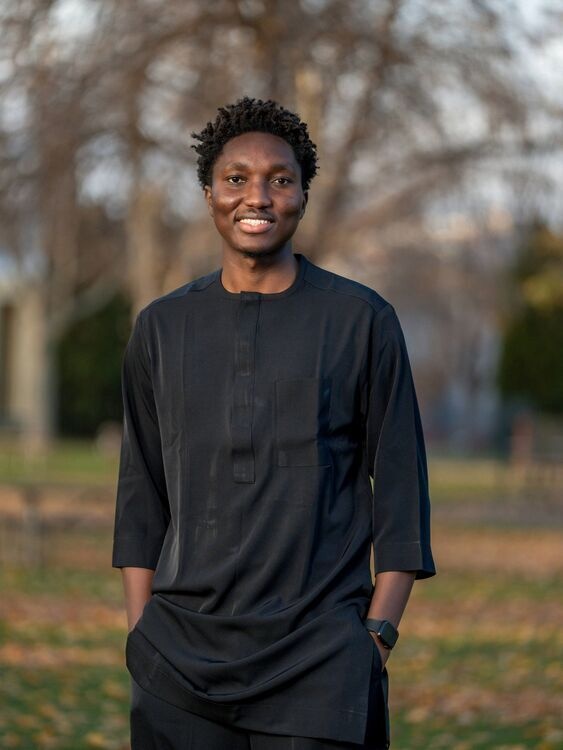
Dissertation Defense: Stanley Akor
Downloads an .ics file · Times are in America/Boise · Google Calendar
Title: Advancing Winter Hydrometeorological Prediction: From Physics-Based Modeling to Artificial Intelligence
Program: Computing PhD
Committee Chair: Alejandro Flores
Committee: Alejandro Flores, Hans-Peter Marshall, James McNamara, John Schreck
Abstract: Winter hydrometeorological prediction remains challenging because of complex interactions among atmospheric forcing, precipitation phase, atmosphere-land interaction, model uncertainty, sparse observations, and computational cost. This dissertation investigates these challenges by progressing from physics-based numerical modeling to artificial intelligence approaches.
First, this dissertation evaluates the sensitivity of mountain snowpack simulations to atmospheric model configuration using WRF–Noah-MP experiments over the Central Idaho Rocky Mountains. Results show that cloud microphysics schemes and lateral boundary conditions substantially influence precipitation, snow water equivalent (SWE), snow depth, and melt timing, demonstrating how uncertainty in atmospheric forcing propagates into land surface predictions. Second, we develop a spatiotemporal deep learning emulator to reproduce Noah-MP SWE over the Colorado Rocky Mountains using ConvLSTM networks driven by WRF meteorological forcings, physiographic variables, and satellite-derived observations. The emulator captures spatial and seasonal SWE variability, outperforms a pixelwise LSTM, and provides substantially faster predictions than the parent physics-based model. Third, we assess the ability of five AI-based numerical weather prediction systems to support precipitation-type diagnosis using an evidential deep neural network and mPING observations. AI weather models maintain stronger skill for rain and snow than for freezing rain and ice pellets, with mixed-phase performance degrading rapidly at longer lead times as shallow thermodynamic structures are lost. Uncertainty estimates also reveal that increasing model confidence does not necessarily correspond to increasing forecast reliability.
Together, these studies demonstrate the complementary strengths and limitations of physics-based and AI-based approaches and highlight pathways toward more accurate, efficient, and uncertainty-aware prediction of winter hydrometeorological processes.
More like this near Boise


Going to Dissertation Defense? Ask me anything about it.
I read the organiser's pages and answer in a few seconds.
Answers are AI-generated · Privacy