

Dr. Lei Tian Distinguished Lecture Series: Matthew Harrington (McGill)
Downloads an .ics file · Times are in America/New_York · Google Calendar
Hey, how's it going? Dr. Lei Tian Distinguished Lecture Series looks like it should be pretty interesting. Want me to help you organise around it?
Event details
Tickets sold by events.cornell.edu
Price on the ticket page
Add to calendar · Downloads an .ics file · Times are in America/New_York · Google Calendar
A bio-inspired playbook for sustainably fabricating strong materials using transient interactions and fluid phases
In nature, certain organisms fabricate materials with properties that outperform those made by humans (e.g., plastics, composites, and adhesive). For example, spider silk is three times tougher than Kevlar, while mussels adhere to wet surfaces with ease—something that our best glues fail to do. Moreover, these materials are produced under biologically and environmentally friendly conditions using biorenewable building blocks. Paradoxically, the key to the impressive mechanical prowess and sustainable production of these strong and tough materials is the use of weak and dynamic non-covalent interactions and transient fluid phases.
To back this claim and demonstrate the immense potential of nature for inspiring next generation sustainable materials, I will present recent findings from our group across several different model systems including mussels, mistletoe, and velvet worms. Our findings indicate that high-performance biological materials are often produced from transient fluid condensates comprised of stimuli-responsive biomolecular building blocks. These concentrated fluid phases enable facile processing into materials under benign conditions, while the stimuli-responsive nature of the biomolecules to different inputs (e.g., pH, redox, salt concentration, mechanical shear) enables rapid transition to fibers, films, and glues possessing hierarchical structure and outstanding mechanical properties, as well as recyclability. The extracted (and abstracted) physicochemical principles are ripe for inspiring novel routes for green and sustainable processing of next generation polymeric materials with circular life cycles.
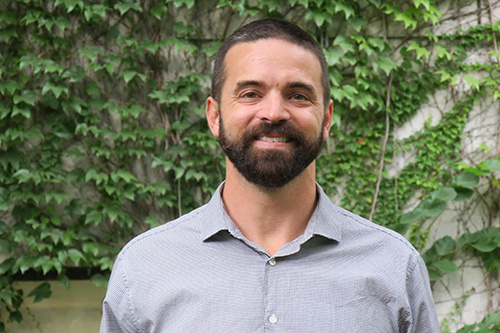
Bio: Matthew Harrington is professor and Canada Research Chair Tier 2 in Green Chemistry in the Department of Chemistry at McGill University, as well as co-director of the McGill Institute of Advanced Materials (MIAM) and director of the McGill Chemistry Characterization (MC2) facility. He received his Ph.D. in 2008 from the University of California, Santa Barbara in the lab of J. Herbert Waite. This was followed by a Humboldt postdoctoral fellowship at the Max Planck Institute of Colloids and Interfaces in the Department of Biomaterials, where he was later a research group leader from 2010 until 2017. His research is focused on understanding biochemical structure–property relationships in the function and formation of biological materials and applying extracted design principles for the development and sustainable production of bio-inspired materials. He was the recipient of the Fessenden Professorship in Science and Innovation Award in 2026 and the Canadian Society of Chemistry Award for Research Excellence in Materials Chemistry in 2025.
More like this near Ithaca


Also on in Ithaca
- Cayuga Bird Club October MeetingMon 12 Oct · Cornell Lab of Ornithology
- Regenerative Studio Fall 2026 EventsTue 13 Oct · Sibley Hall Room 106
- Emerging Tech Dialogues: From Ideas to Impact, Celebrating IT innovation across Cornell and the people bringing it to lifeTue 13 Oct · 9am · Statler Hall
- Emerging Tech Dialogues - From Ideas to Impact: IT innovation Across CornellTue 13 Oct · 9am · Statler Hall
- Exploring the Ethics of AI in Community-Engaged LearningTue 13 Oct · 2pm · Gates Hall
Going to Dr. Lei Tian Distinguished Lecture Series? Ask me anything about it.
I read the organiser's pages and answer in a few seconds.
Answers are AI-generated · Privacy