

DAAAS Fall Faculty Research Seminar(s)
Downloads an .ics file · Times are in America/Los_Angeles · Google Calendar
Other dates
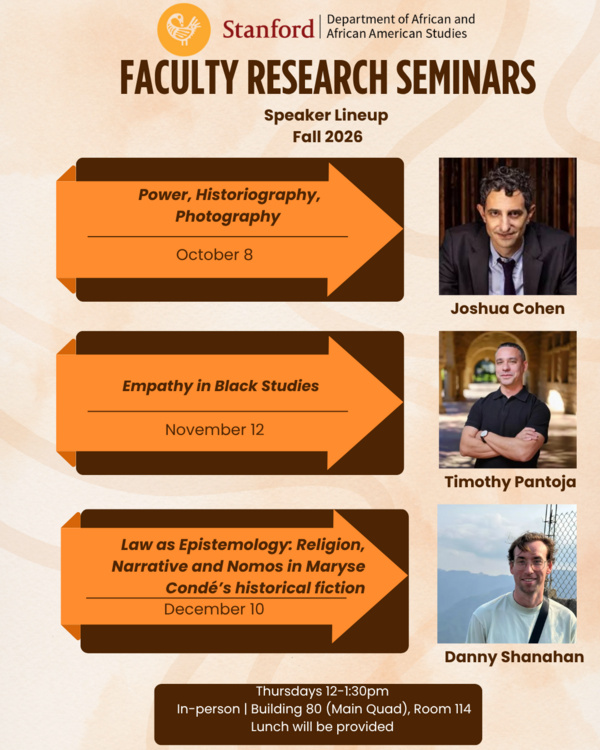
Please join DAAAS for the Fall Quarter Faculty Research Seminars on first thursdays from 12-1.30pm.
The speaker line-up:
October 8: Power, Historiography, Photography--Professor Joshua Cohen, Associate Professor of Art and Art History and, by courtesy, of African and African American Studies.
Description: The place of photography in the historiography of African modernism raises significant questions for the discipline of art history and for African and postcolonial studies more broadly. Independence-era portraits and nightlife scenes by the Malian photographers Seydou Keita and Malick Sidibé in Bamako, and by the Angolan-born photographer Jean Depara in Léopoldville/Kinshasa, among others, are commonly accorded a documentary authority that anchors relationships between aesthetics and politics, modern self-fashioning and decolonization. Yet to recall anthropologist Simon Ottenberg’s 1993 observation that African art studies aimed mostly “to show the positive and cohesive view of African life in the face of so many negative stereotypes in the West” is to ask how much the field’s aesthetic and political parameters have really changed since that time. Even when independence-era photos are read in political terms, they tend to imply a somewhat selective vision of the political gleaned through the confidence and style of individual portrait subjects and image-makers. How do such readings mesh with the much more complicated histories of African decolonization and the Cold War that are by now well documented? And what do such readings suggest about the current role of art history, the art museum, and the humanities within global power structures and information ecosystems?
Joshua I. Cohen is a historian of modern art specializing in postcolonial, African/diaspora, and global Cold War studies. His research and teaching explore modernist practices and discourses spanning francophone West Africa, southern Africa, Europe, the Caribbean, and the United States
November 12 : Empathy in Black Studies--Dr.Timothy Pantoja, Mellon Fellow of the Humanities at Stanford University and a Lecturer in the Department of African and African American Studies.
Description: This talk traces the productive tensions between empathy as a moral idea and empathy as an aesthetic practice in Black Studies. In particular, I analyze how Zora Neale Hurston’s ideas on embodied spectatorship forecasts both the critique of empathy as a moral shortcut and the current turns towards the haptic in black aesthetics. While Hurston is celebrated as an anthropologist, novelist, and choreographer her aesthetic insights on participatory perception, what she calls “watching”, remain under-appreciated. Therefore, this talk examines the ways Hurston improvised upon aesthetic ideas across the Enlightenment to contemporary ideas on kinesthesia to theorize the reflective dimensions of everyday practices of black expressivity.
Dr. Pantoja's research explores the ways Black and Caribbean literature and art theorize reflection, doubt, and what it means to participate with the objects that mediate our encounters with each other and a shareable world. His current book project, Scenes of Reflection: Compelling Insinuations, Empathy, and Absorption, analyzes portrayals of reflection in black modernist art and literature alongside the aesthetic evolutions of empathy as a mode of perception
December 10: Law as Epistemology: Religion, Narrative and Nomos in Maryse Condé’s historical fiction-Dr. Danny Shanadan, is a visiting postdoctoral fellow working collaboratively between Stanford University and University College Cork, Ireland.
Description:Following Subaltern Studies’ contention that subaltern ontologies and epistemologies are fundamentally religious, the talk argues that fictional work conceptualizes religion as a form through which the subjectivities and political goals of the historically marginalized are often expressed. It will address the shifting roles of law and religion in the lives of the marginalized through the Islamization of West Africa in Maryse Condé’s Segu, the transformation of Hindu peasant piety into Gandhian nationalist fervor in Raja Rao’s Kanthapura and in the burgeoning genre of convent murder-mystery in Ireland. I argue that fictional work intervenes on historical accounts of religious practice by depicting the social dynamism of belief systems. In historical fiction, religious hermeneutics become simultaneously law-defending and law-positing—both deeply intertwined with hegemonic legal narratives and at the same time a potentially liberatory, alternative epistemology.
Dr. Shanadan completed his PhD at the University of Cambridge in 2024 and completed an Irish Research Council postdoctoral fellowship at University College Cork in 2025. His first monograph, ‘Literature and Emergency Law in Kashmir and Northern Ireland: Disturbed Areas’ combines law and literature studies with legal history to reveal the common British colonial roots of modern emergency laws used in the conflicts in Kashmir and Northern Ireland. This publication will be launched on wed. Nov. 11 2026 in building 80.
Location: Building 80 (Main Quad), Room 114
Lunch will be provided.
Please RSVP Here.
Hope to see you there.
More like this near Palo Alto


Going to DAAAS Fall Faculty Research Seminar(s)? Ask me anything about it.
I read the organiser's pages and answer in a few seconds.
Answers are AI-generated · Privacy