

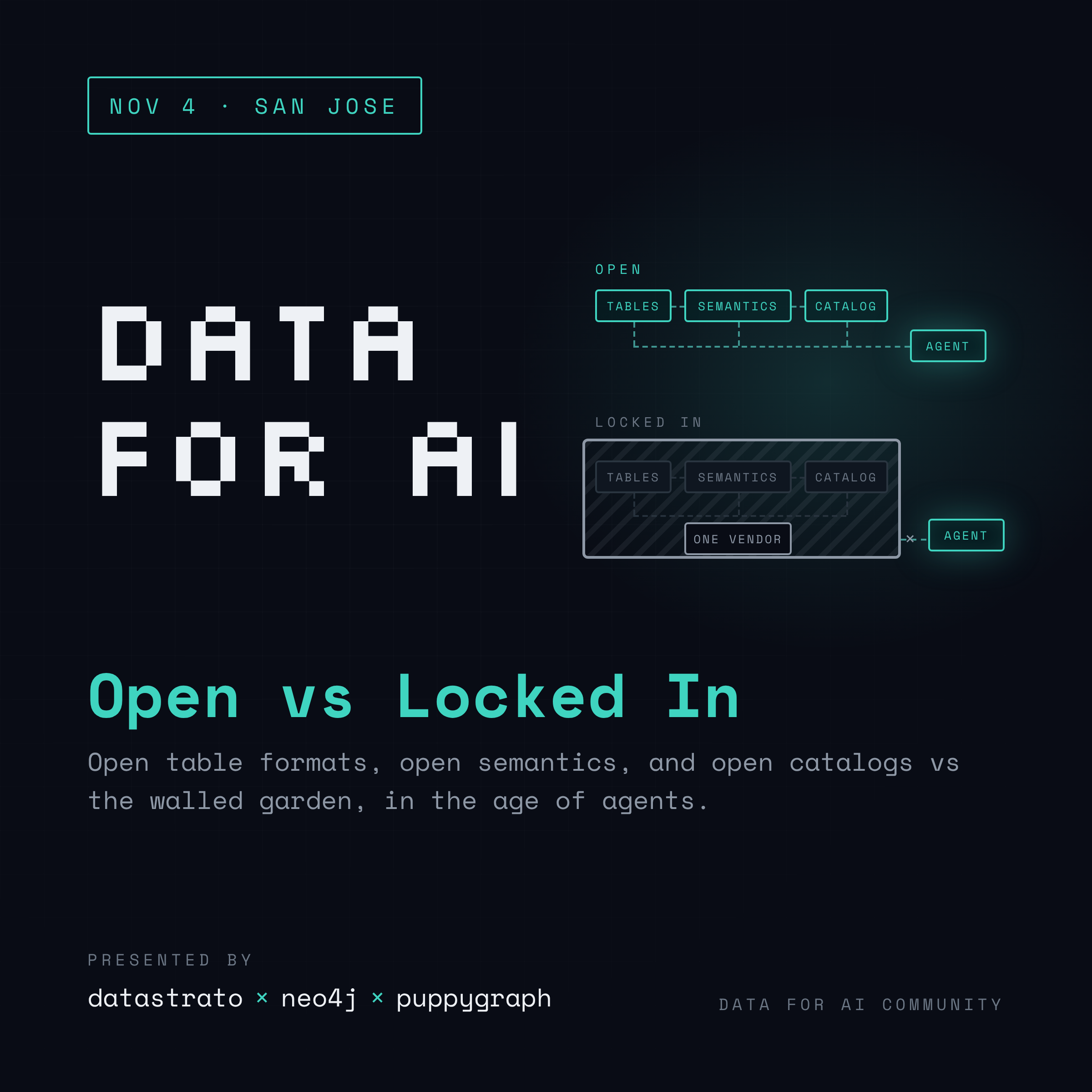
Data for AI: Open vs Locked In
Downloads an .ics file · Times are in America/Los_Angeles · Google Calendar
Open table formats won the storage war. Then agents showed up, and every platform decided it wants to be the one place they live. The walled garden is back, and this time it is being built around the catalog, the semantic layer, and the agent runtime instead of the file format.
That's the theme for this Data for AI meetup: Open vs Locked In. Open table formats, open semantics, and open catalogs versus the walled garden, in the age of agents. We'll get into what "open" actually buys you when the user of your data is an agent, where interoperability holds up in production and where it quietly doesn't, and the cases where locking in was the right call.
The talks
Rent the Models. Own the Metadata Graph.AJ Corcoran, Angel Investor and GTM Advisor, Paper Compute. Lightning talk.
An agent that answers questions over company data needs three things. It needs to know which source is authoritative. It needs to know what each metric means. It needs to know who is allowed to see the answer. Those three things are metadata. The legacy catalogs stored metadata for human searchers. Agents are now the main customer of the catalog. This talk makes one argument about ownership. A company can rent its models. Every competitor can rent the same models. A company should not rent the map of what its own data means. The metadata graph holds the company's definitions. The lineage shows where each number came from. The definition libraries hold the company's private language. That layer survives every model swap. The talk closes with the opposite case. Locking the graph inside a vendor platform can still be the right call for a small team. The deciding factor is not ideology. The deciding factor is whether the definitions are the company's asset or the vendor's asset.
Ontologies in Practice: Apache Jena and Apache GravitinoMark Hoerth, Product Lead, Datastrato
What an ontology is, and what it now decides. Ontologies are a twenty-five-year-old standard the enterprise skipped: classes, properties, and relationships, with rules software can act on, which is what separates an ontology from the glossary you already bought. Mark covers why the enterprise skipped it, what changed now that an agent has to decide things, and how Apache Jena and Apache Gravitino take an ontology from definitions to what the catalog enforces. The ontology decides, the catalog enforces.
Open Format, Closed Index: the Lock-In Iceberg Didn't SolveRaghvendra Yadav, Staff Software Engineer and Tech Lead, StarTree
Open table formats made the data portable: any engine can read an Iceberg table. The indexes never came with it. The spec standardizes data and metadata, but the structures that actually make a query fast (inverted indexes, secondary indexes, vector indexes) stay mostly engine-private. The moment a workload needs more than a scan, the engine that built the index becomes the engine you are stuck with. I'll walk through building Lucene-backed full-text search directly on Iceberg tables: where an index can live so it stays portable, what Puffin does and does not cover, how index lifecycle collides with ordinary table maintenance like compaction and snapshot expiry, and what broke when we tried to keep it engine-neutral instead of burying it inside one query engine. Then the uncomfortable part: agents make this worse. Retrieval is becoming the dominant access pattern over lakehouse data, and retrieval is exactly what needs indexes. If indexes stay outside the open spec, the agent layer re-locks the lakehouse through the back door.
Queries with Meaning: Graphs as Semantic EnginesJaz Ku, Solution Architect, PuppyGraph
Agents are the new database user, but they meet enterprise data the hard way: thousands of tables with cryptic names like custref and enttyp, and relationships that live only in people's heads. To use that data well, an agent needs to know what it means, not just what it's called. Graphs make meaning part of the query. When entities and relationships are first-class (Customer OWNS Account, Account HAS RiskFlag), the query itself says what it's asking, and agents can draw on what they already learned in pre-training instead of guessing at a schema. The graph becomes a semantic engine.
In this talk, we show how a PuppyGraph discovery agent automatically finds entities, relationships, and semantics across thousands of tables and builds an ontology that people review rather than write. PuppyGraph then queries the existing data directly as a graph, with no ETL, no data migration, and no second copy, so semantic queries run at enterprise scale. We'll demo the path from raw tables to ontology to graph queries, and explain why semantic queries are unreasonably effective for agentic systems.
Practitioner talks, Q&A, and time with the people who gave them, with food and drinks on us. Built for data engineers, AI/ML engineers, platform architects, and the leaders they build for. Seats are capped, so grab your spot now.
Timing
Doors open at 5:00 PM for food, drinks, and conversation. Talks run from 5:30 to 7:30 PM, then the room is yours until 8:00. Come at 5 if you want to catch the speakers before they're on.
Getting there
Wednesday, November 4. OneSpace, 2665 North 1st St, San Jose, CA 95134. Suite 214 is on the 2nd floor; follow the directory on the wall.
Keep the conversation going
The best threads from these meetups don't end at the venue. Join the community on Discord to swap notes with speakers and other builders between events: datastrato.ai/discord
Want to help us run the event?
Data for AI is community-run, and a couple of extra hands make every meetup better. If you can help with check-in, setup, AV, or photos and video on the night, we'd love to have you: https://forms.gle/dMLUXp9Qjy6Lx5MV8
Sponsors
This event is made possible by our sponsors, who keep the Data for AI community running.
Datastrato is the original creator of Apache Gravitino, the open-source metadata lake that puts tables, models, and files under a single catalog, lineage graph, and access layer. They are building the open data fabric platform to accelerate trusted AI, and they host the Data for AI community.
Join the Datastrato community Discord
Read the Datastrato blog
Follow Datastrato on LinkedIn
Subscribe to Datastrato on YouTube
Listen to the Data for AI podcast
Try Apache Gravitino on GitHub (open source, no form and no payment required)
Get started with Datastrato Enterprise
PuppyGraph is the first and only real time, zero-ETL graph query engine in the market, empowering companies to transform existing relational data stores into a unified graph model in under 10 minutes, bypassing traditional graph databases' cost, latency, and maintenance hurdles.
Join PuppyGraph Community Slack
Check out PuppyGraph Engineering Blog
Follow PuppyGraph on LinkedIn & Twitter
Subscribe to PuppyGraph YouTube
Download PuppyGraph Forever Free Developer Edition (no form & no payment required)
Neo4j is the graph database behind many of the world's knowledge graphs. Its native property-graph engine and Cypher query language make relationships a first-class citizen, which is why teams reach for it on connected-data problems and, increasingly, GraphRAG for grounding LLMs.
Join the Neo4j Discord
Read the Neo4j developer blog
Follow Neo4j on LinkedIn
Get started free with Neo4j Aura
Want to reach the Data for AI community with your brand? E-mail [email protected].
More like this near Santa Clara


Going to Data for AI? Ask me anything about it.
I read the organiser's pages and answer in a few seconds.
Answers are AI-generated · Privacy