

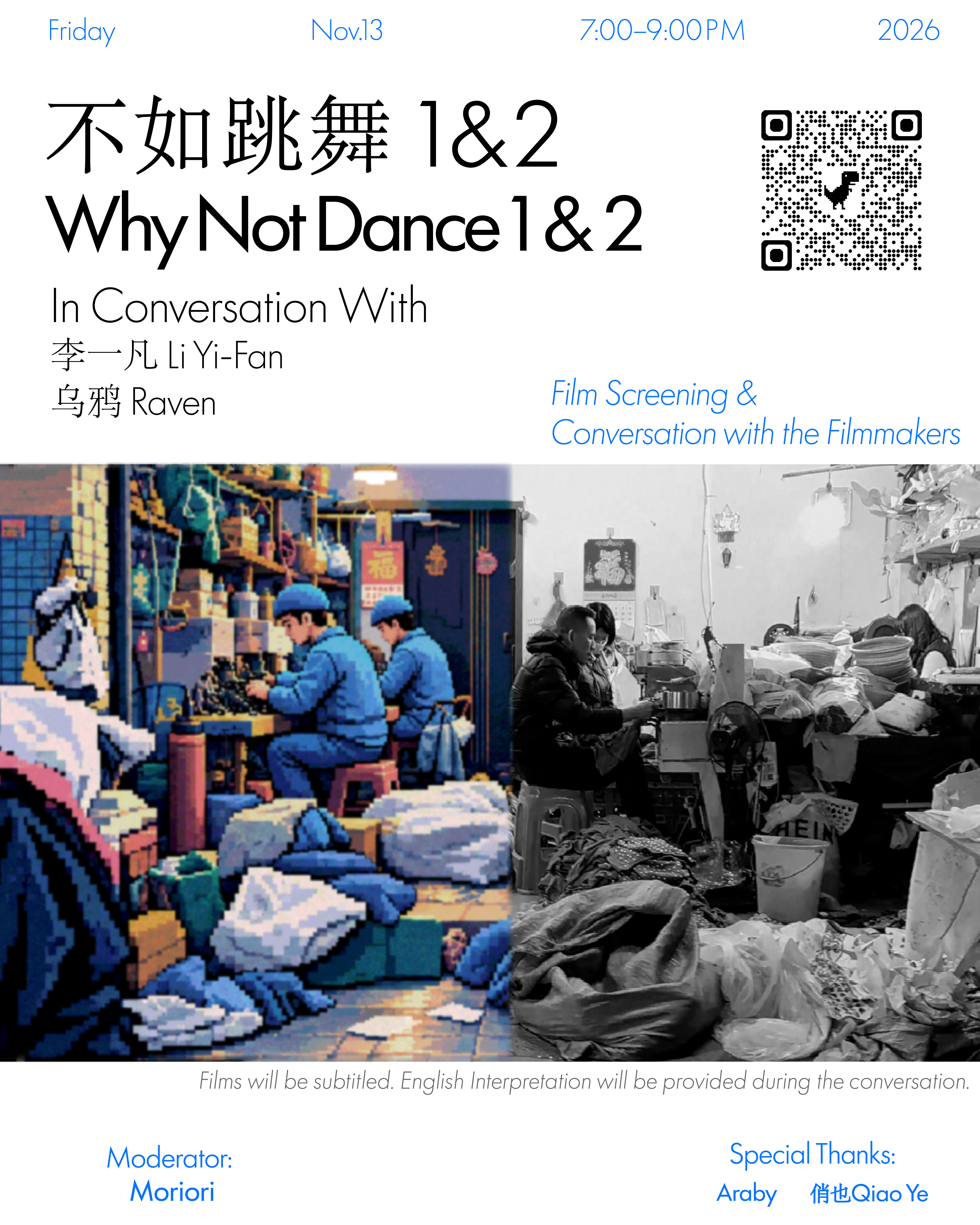
《不如跳舞1&2》放映及跨洋主创对谈:李一凡,乌鸦 | Why Not Dance 1 & 2 (Dir. Li Yi-Fan): Screening and Conversation
Downloads an .ics file · Times are in America/New_York · Google Calendar
English version below.
《不如跳舞1&2》 Why Not Dance 1 & 2
李一凡导演新作 | 电影放映及映后跨洋对谈
Film Screening & Post-Screening Conversation Across the Ocean
Friday, November 13, 2026
7:00–9:00 PM (ET)
📍 Accent Sisters, New York
89 5th Ave 702, New York, NY 10002
本次放映将呈现李一凡导演的新作《不如跳舞1&2》。该系列为香港大馆当代美术馆“保持在线:全球供应”委约创作的作品,由说唱式音乐影像与纪录短片组成。
继《杀马特我爱你》之后,李一凡再次将目光投向新一代的年轻劳动者。在这两部短片中,我们从工人们自身的讲述出发,走近他们的劳动经历、自我认识,以及他们所处的工作世界与日常生活。
映后,我们将与《不如跳舞》系列创作者李一凡、乌鸦从中国跨洋连线,由研究者及活动家 Moriori 主持对谈。
我们希望借由《不如跳舞》,从工人们具体的劳动与生活经验出发,展开关于劳动结构、个人主体性,以及不同社会位置之间如何相互理解和建立联系的讨论。
以下是我们希望一起思考的几个方向:
01 从劳动到生活:流水线之外,还有什么被安排了?
除了工厂中重复的劳作,流水线、工时与管理制度还如何影响工人的身体、休息、爱好、亲密关系和对未来的期待?当一个人离开工厂,劳动对生活的影响是否也随之结束?
02 从个人遭遇到社会关系:为什么灵活的劳动反而让人更不自由?
外包与灵活就业看似提供了更多选择,但这些劳动方式如何与长工时、欠薪、缺少社会保障,以及身体和精神上的损耗联系在一起?
这些问题在多大程度上来自个别雇主或劳动中介,又如何与更广泛的城乡关系、户籍制度、家庭责任和劳动力市场的组织方式相关?
03 从劳动到主体:谁有资格想象未来?
电影中的年轻工人如何理解自己的过去、现在与未来?他们对好生活的期待,与社会主流叙事中的进步、成功和稳定有什么不同?
当自动化被描述为社会进步,当城市中产生活被视为成功的标准,不同位置上的人们如何理解这些变化,又有哪些生活经验与未来想象容易被忽略?
在现实的限制之中,人们如何理解自身处境,寻找行动、表达与选择的空间?
04 从理解他人到共同改变:我们怎样走到一起?
当我们试图观看、研究、理解或描述他人的生活时,我们站在什么位置上?不同的生活经验与实践,又如何产生各自的知识、判断与想象?
身在纽约,我们为什么关注中国及世界其他地方的劳工与游民?不同地方的劳动与生活处境,和我们自身有哪些联系,又有哪些差异?
跨越地域与阶级,我们如何认识彼此?是什么让人们走到一起,又有哪些相遇、关系与实践,让我们得以共同想象不同的生活可能?
放映结束后,Moriori 将以几个问题开启与创作者的对谈,随后开放现场观众提问与交流。以上问题是我们希望探索的方向,而非预设的讨论结论。我们也期待在现场听到更多不同的经验、问题与思考。
对谈嘉宾(线上连线) | In Conversation With (Joining Remotely)
李一凡 Li Yi-Fan
乌鸦 Raven
对谈主持 | Moderator
Moriori
联合策划 | Co-Curated by
Clone Chen
Qingyu Peng
特别鸣谢 | Special Thanks
俏也 Qiao Ye
语言及参与方式
影片配有字幕,映后对谈提供英文翻译。创作者将从中国线上参与实时对谈。
延伸阅读 | Suggested Reading
放映前,大家也可以参考以下相关阅读,提前了解影片及其创作背景,包括一篇李一凡导演访谈,以及在国内放映时,创作者与影片中的工人进行对谈的记录。
No. 1
https://jilucommune.com/cn/library/writings/105
No. 2
No. 3
No. 4
Why Not Dance 1 & 2
New Films by Li Yi-Fan
Film Screening & Post-Screening Conversation Across the Ocean
Friday, November 13, 2026
7:00–9:00 PM (ET)
📍 Accent Sisters, New York
89 5th Ave 702, New York, NY 10002
This screening presents Why Not Dance 1 & 2, the latest works by director Li Yi-Fan. Commissioned by Tai Kwun Contemporary in Hong Kong for the exhibition Stay Connected: Supplying the Globe, the two short films comprise a rap-style music video and a documentary short.
Following We Were SMART, Li Yi-Fan turns his attention to a new generation of young workers. Through the workers' own accounts, these two films explore their experiences of labor, their understanding of themselves, and the worlds of work and everyday life they inhabit.
Following the screening, we will be joined live from China by the filmmakers Li Yi-Fan and Raven for a conversation moderated by scholar and activist Moriori.
Through Why Not Dance, we hope to begin with the workers' concrete experiences of labor and everyday life, opening up a broader discussion about labor structures, personal agency, and how people occupying different social positions might understand and relate to one another.
Below are some of the questions we hope to explore together.
01 From Labor to Life: What Does the Assembly Line Organize Beyond Work?
Beyond the repetitive tasks of factory production, how do assembly lines, working hours, and workplace management shape workers' bodies, rest, interests, intimate relationships, and expectations for the future? When someone leaves the factory, does the influence of work on their life end there?
02 From Individual Experiences to Social Relations: Why Can Flexible Work Leave People with Less Freedom?
Outsourcing and flexible employment appear to offer workers greater choice. How do these arrangements relate to long working hours, unpaid wages, inadequate social protections, and physical and psychological strain?
To what extent are these conditions the result of individual employers or labor intermediaries, and how are they connected to broader structures, including rural–urban relations, the household registration (hukou) system, family responsibilities, and the organization of labor markets?
03 From Labor to Agency: Who Gets to Imagine the Future?
How do the young workers in these films understand their past, present, and future? How might their visions of a good life differ from dominant narratives of progress, success, and stability?
When automation is presented as social progress, and the urban middle-class lifestyle is held up as a measure of success, how do people in different social positions experience and understand these changes? Whose experiences and visions of the future tend to be overlooked?
Within the constraints of their circumstances, how do people make sense of their situations and find room for action, expression, and choice?
04 From Understanding Others to Collective Change: How Do We Come Together?
When we watch, study, seek to understand, or describe other people's lives, what positions do we occupy? What kinds of knowledge, judgment, and imagination emerge from different lived experiences and practices?
Here in New York, why are we interested in the lives of workers and drifters in China and elsewhere? What connections exist between their conditions of labor and everyday life and our own, and what differences remain?
Across geographical and class differences, how do we come to understand one another? What brings people together, and what encounters, relationships, and practices might allow us to imagine different possibilities for living collectively?
After the screening, Moriori will open the conversation with a few questions for the filmmakers, followed by an open Q&A with the audience. These questions are intended as possible directions for discussion rather than predetermined conclusions. We welcome the different experiences, questions, and perspectives that audience members bring to the conversation.
In Conversation With (Joining Remotely)
Li Yi-Fan
Raven
Moderator
Moriori
Co-Curated by
Clone Chen
Qingyu Peng
Special Thanks
Qiao Ye
Language & Participation
Films will be subtitled. English interpretation will be provided during the post-screening conversation, with the filmmakers joining live from China via video call.
Suggested Reading
Ahead of the screening, we invite you to explore the following readings for further context on the films and their making. These include an interview with director Li Yi-Fan, as well as records of conversations between the filmmakers and the workers featured in the films at previous screenings in China.
Suggested readings are in mandarin Chinese.
No. 1
https://jilucommune.com/cn/library/writings/105
No. 2
No. 3
No. 4
More like this near New York



Going to 《不如跳舞1&2》放映及跨洋主创对谈:李一凡,乌鸦 | Why Not Dance 1 &? Ask me anything about it.
I read the organiser's pages and answer in a few seconds.
Answers are AI-generated · Privacy