

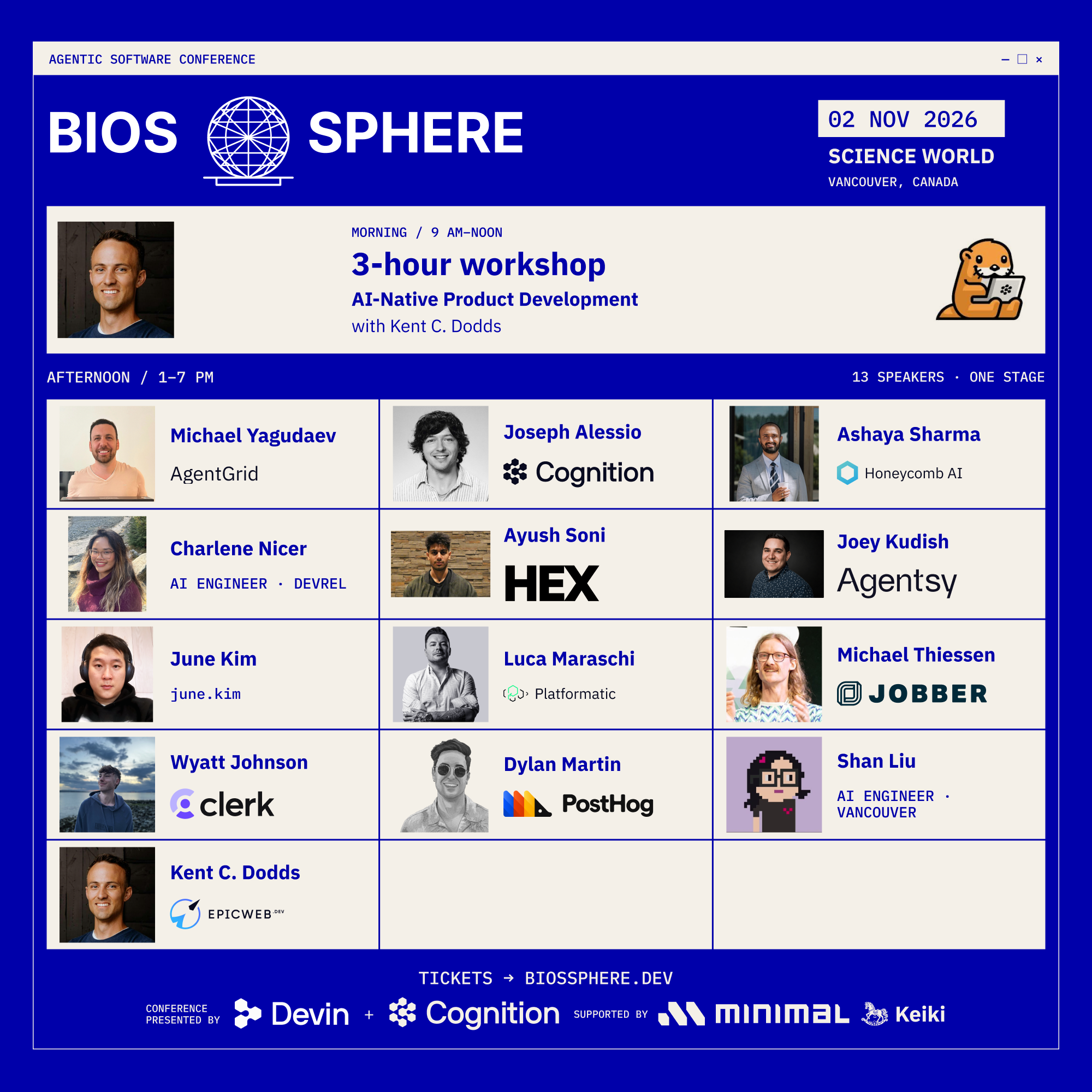
BIOS SPHERE — Featuring Kent C. Dodds
Downloads an .ics file · Times are in America/Vancouver · Google Calendar
Morning workshop · Presented by Orchid
AI-Native Product Development with Kent C. Dodds
Kent leads the Product track at MEGA, where the goal is to direct AI toward meaningful system changes and verify what ships. This three-hour, hands-on workshop brings that framework into the room: using agents across the full product-development loop without giving up ownership or judgment.
Orchid is fully subsidizing the workshop, making it possible for the BIOS SPHERE organizers to offer workshop-only admission for CA$100 and a workshop + BIOS SPHERE bundle for CA$125.
Exploration — understand user flows, system behavior, history, and the problem worth solving.
Planning — shape scope, map risk, and turn intent into a strategy agents can execute.
Execution — coordinate direct work, delegated work, parallel agents, handoffs, and merge points.
Feedback — steer with system logs, visual review, human judgment, and concrete artifacts.
Engineering — simplify, work from primitives, maintain conventions, and manage technical debt.
Delivery — run integration checks, monitor the release, and make unresolved risks explicit.
The session is a workshop-style lecture with lecture-style seating in the Science Theatre at Science World, Vancouver. Workshop and full-day ticket holders: please arrive at 8:30 a.m. Vancouver time for workshop check-in and seating; the workshop begins at 9:00 a.m. If you’re bringing a laptop, please make sure it’s fully charged before you arrive, as power outlets won’t be accessible from the seating area. Workshop and BIOS SPHERE admission are sold separately. Conference-only guests should arrive separately at 12:15 p.m. Vancouver time for the 1:00 p.m. conference.
Monday, November 2 · 09:00–12:00 · 100 participants · Presented by Orchid
BIOS SPHERE is a one-day gathering for Vancouver's software community. Join us at Science World on Monday, November 2 for a morning workshop followed by an afternoon of talks, demos, coffee, and conversation.
Tickets and times
Choose one ticket for the part of the day you are attending:
Conference only · 13:00–19:00 · CA$35 Early Bird / CA$50 Regular
Kent C. Dodds workshop only · 09:00–12:00 · CA$75 Early Bird / CA$100 Regular · Science World theatre, Vancouver
Full day · 09:00–19:00 · CA$100 Early Bird / CA$125 Regular · workshop and conference
Each Early Bird tier has 25 tickets and closes when sold out or September 30, 2026 at 23:59 PT, whichever comes first.
Refunds and transfers
Full refunds are available through October 19, 2026 at 23:59 PT. After that deadline, tickets may be transferred to another attendee but are not refundable. Refunds and transfers must be handled through Luma. Contact [email protected] for help.
Explore the programme and event details at biossphere.dev.
Made possible by Devin
BIOS SPHERE is made possible by Devin, the AI software engineer created by Cognition. Devin works inside a team's existing codebase and tools: planning, writing, testing, and shipping production code across migrations, bug fixes, documentation, and multi-repository projects. The programme will also close with a Devin session; the presenter, title, and session details will be announced soon.
Welcome, Minimal
We're pleased to welcome Minimal as a BIOS SPHERE sponsor. Thank you for supporting Vancouver's community of builders.
Speakers announced so far
Kent C. Dodds · EpicWeb
X · LinkedIn
Kent is a software engineer and educator who created React Testing Library and now builds EpicWeb, EpicReact, EpicAI, and EpicProduct. He will lead the morning workshop and join the afternoon conference.
The Last Software Engineer
As AI takes on more coding, what makes a great software engineer? Kent explores product thinking, judgment, and accountability—and how to keep building software worth having.
Michael Yagudaev · Co-founder · AgentGrid
X · LinkedIn
Michael is Co-founder at AgentGrid.
Build agent teams that ship
We built our own tool, AgentGrid, because we were frustrated with the tools that were available to us. None of them got it right. The first problem we solved was persisting sessions in an organized way. Once we solved that we moved to orchestration, organization, workflows and collaboration.
This session is the lessons we learned along the way. Practical ideas that can be applied to any agentic workflow.
Takeaway: Set up an agentic engineering workflow for yourself and your team.
Joseph Alessio · Brand Lead · Cognition
X · LinkedIn
Joseph is Brand Lead at Cognition.
More Tokens, More Problems: Designing Things that Matter in the Age of Software Abundance
In an era where execution is cheap, what is worth creating? Examining the process of designing for Cognition, discernment over taste, and the crisis of meaning at the intersection of art and technology.
Talk · 30 minutes (tentative). Exact time to be announced.
Ashaya Sharma · AI Engineer & Co-founder · Honeycomb AI
Ashaya is an AI engineer and co-founder at Honeycomb AI. He builds with agents in public, clones software he wants to exist, and uses those experiments to take on bigger systems.
Build What You Want. Build bigger.
Agents can now clone the tools we already love. The interesting question is what we do after that. This presentation is in two parts. First: use coding agents to clone favourite software and ship the clones as open source—what works, what breaks, and how to go from “it kind of works” to something other people can actually run. Second: take that same loop and point it at bigger ideas that do not already exist.
The session starts with a live agent build on stage. The goal is to have a working artifact by the end of the talk, not a slide about one.
Joey Kudish · Co-founder · Agentsy
X · LinkedIn
Joey Kudish is a software developer and AI consultant with 20+ years building on the web. He’s the co-founder of Agentsy, an embedded design and engineering studio.
Measuring AI visibility without fooling yourself
Being mentioned by an AI tool is not the same as being recommended. Joey shows how to build questions customers actually ask, compare answers across AI tools, inspect cited sources, and measure visibility over time. Learn how to avoid misleading results and identify practical improvements to AI discoverability.
June Kim
June Kim is a Vancouver-based AI engineer with over a decade of experience building software at Google, Loom, and startups. June explores how we work with AI and how it can share answers with evidence anyone can check.
How does your agent know that it's ‘Done’? Prove it.
Ayush Soni
X · LinkedIn
Ayush Soni is the Creative Director and Founder at HEX - an AI native full cycle creative studio working with fast growth startups.
How to effectively design in the age of AI
Ayush shares practical ways to use agentic tools in design and design-engineering workflows, drawing on creative work for startups including Replit, Exa, and Composio. The talk also examines the dangers and ethical considerations of creative generative AI.
Luca Maraschi · Co-founder & CEO · Platformatic
Luca is the co-founder and CEO of Platformatic, where he and Matteo Collina are rethinking how Node.js applications and AI agents run in production. He brings twenty years of technical leadership experience, has founded and exited three companies, and previously led engineering at mobileLIVE and Telus Digital.
Agents Are Workflows: Determinism, Journals, and State Without a Landlord
How do you build AI agents that can survive crashes, pause for human input, and reliably resume their work? Luca explores agents as durable workflows, using deterministic replay and journals to preserve state. He also examines who owns an agent's history and what it would take to run agents across organizations without relying on a single host.
Michael Thiessen · Software Engineer, Applied AI · Jobber
Michael Thiessen is a software engineer doing applied AI at Jobber, where he builds evals, PR review agents, and coding agent harnesses. He is known in the Vue.js community for his courses and workshops, talks at conferences around the world, and co-hosting the top Vue.js podcast.
Benchmarking coding agents in your own codebase
Which model should you use for coding work, and how much reasoning effort is worth the cost? I’ll use Jobber’s coding-agent evals as a case study in answering those questions. We turn real work from our codebase into repeatable tasks, run agents against the same cases, and judge the resulting patches. I’ll show how to think about evals, check whether our judges are reliable, and interpret results when runs fail or scores disagree. You’ll leave with a practical approach to building benchmarks that can inform decisions in your own codebase.
Wyatt Johnson · Staff Software Engineer · Clerk
X
Wyatt Johnson spent years on the Next.js core team at Vercel, helping build React Server Components support, Partial Prerendering, and Cache Components. Before that he built newsroom and community tooling at Mozilla, The Coral Project, and Vox Media. He's now a Staff Software Engineer at Clerk, building CLI and MCP tooling for agentic development.
Session details coming soon.
Dylan Martin · Agentic Workspaces · PostHog
Dylan works on self-driving agentic workspaces (I promise it's a real thing) at PostHog, and before that he led the feature flags team, where he had a lot of fun improving the performance and UX of that service. Before PostHog he worked at a whole bunch of startups (most of which you've probably heard of) and generally enjoys being at that extremely fun intersection of high ownership and high impact. He loves typed languages, skiing, jazz piano, golf, design, and powerlifting.
From Snakes to Crabs: Lessons learned from rewriting PostHog feature flags from Python to Rust
Dylan shares lessons learned from rewriting PostHog's feature flags service from Python to Rust.
Charlene Nicer · Senior Software Engineer · Developer Relations
X · Website
Charlene is a developer relations professional and software engineer based in Vancouver, BC. She started out in fintech, researching and building institutional blockchain architecture and integrations. Her current work is in AI engineering, where she helps small businesses automate manual work with AI workflows and decides which operations actually need intelligence and which are better handled by plain automation. She has spoken at conferences and builds technical content that makes complex infrastructure understandable to working engineers.
Not Everything Needs a Prompt
Do we just throw all our problems at agents and hope for the best? That's what many small businesses do: a jeweler, a chef or an artist hands everything to the chat window, until the business can't run without it. In this talk, I share what I've learned helping non-technical businesses multiply their output and get their time back: knowing where agents shine and where simple automation wins, checking that the work is actually right before customers see it, and building enough trust to let go of the busywork for good. You'll leave with a practical playbook for making agents work for people who just want their business to run, and a new reason to pause before you write that next prompt.
Shan Liu · AI Engineer · Vancouver
X · LinkedIn
Shan Liu is an AI engineer with ten years of software engineering experience across 3D-printed medical devices, fintech, private equity, and health tech. Moving between industries shaped how Shan validates AI systems and tests the promise of instant expertise.
Can AI Make You an Expert in Any Industry Overnight? I Built a Self-Improving Agent to Find Out
Can an AI agent become an expert in an unfamiliar industry overnight? Shan built a self-improving agent to test that promise on a single-cell biology task. This pilot experiment explores what the agent discovered, how it compared with a simple no-AI baseline, and why the same prompt produced different results across two runs. The takeaway: build the judge before the agent, keep a locked test set, calibrate a noise threshold, compare against a simple baseline, and run the experiment more than once.
More speakers will be added as they are confirmed.
BIOS SPHERE is for engineers, designers, founders, students, researchers, product people, and independent builders. You do not need to arrive knowing anyone.
The day
09:00–12:00 · Kent C. Dodds workshop · Presented by Orchid · 100 seats
13:00–19:00 · BIOS SPHERE main conference · 200 seats
Monday, November 2, 2026
Science World, 1455 Quebec Street, Vancouver, BC V6A 3Z7
Stage presentations will be recorded and published after the event. Event photography and filming will also take place. Registration includes an optional media-consent choice; attendees who decline can request a no-photo identifier at check-in. Choose a conference-only, workshop-only, or full-day ticket during registration.
More like this near Vancouver


Going to BIOS SPHERE? Ask me anything about it.
I read the organiser's pages and answer in a few seconds.
Answers are AI-generated · Privacy