

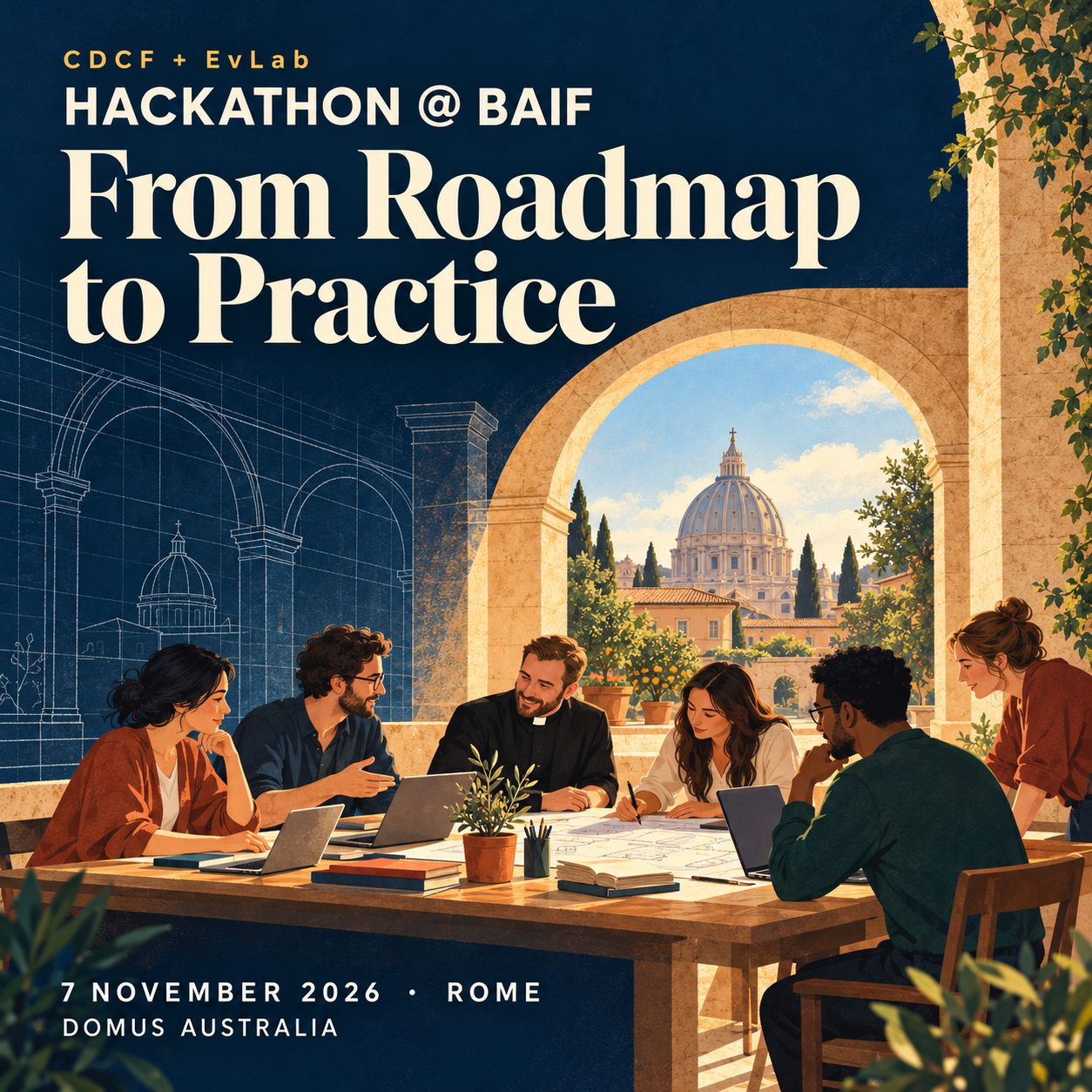
CDCF + EvLab Hackathon @ BAIF: From Roadmap to Practice
Downloads an .ics file · Times are in Europe/Rome · Google Calendar
Hey, how's it going? CDCF + EvLab Hackathon @ BAIF: From Roadmap to Practice looks like it should be pretty interesting. Want me to help you organise around it?
Event details
Tickets sold by luma.com
Add to calendar · Downloads an .ics file · Times are in Europe/Rome · Google Calendar
The hands-on culmination of Workshop 1: Building and Scaling Catholic AI: A Collaborative RoadmapWhen: Saturday, November 7th, 9:00 a.m.–5:00 p.m., followed by closing Mass at 5:00 p.m. Full schedule to come, small details subject to change.Where: Domus Australia Roma, Via Cernaia 14 / B, 00185 Roma - Italia. Coffee, lunch, and Mass will all take place on site.Contact: Taylor Black — [email protected]
Workshop 1 asks the Catholic AI community to identify its most important problems, propose practical solutions, and name the people who will carry them forward. The CDCF Hackathon takes the next step: bringing builders together with parish and diocesan leaders to begin turning those commitments into working solutions.
Convened by the Catholic Digital Commons Foundation, in collaboration with Evangelization Lab and the Leonum Institute, the hackathon brings participating parishes and dioceses from the United States and around the world into the work as partners. They bring concrete needs, local knowledge, and the judgment needed to determine whether a proposed solution would actually serve their communities. Developers, designers, strategists, and Church leaders work alongside them to build, test, and learn.
Drawing on the priorities and initiatives emerging from Workshop 1, teams will:
Start with a real need. Define a specific parish or diocesan problem with the people who experience it, including what success would look like in their setting.
Build on what exists. Use available tools, shared resources, and existing projects to develop a prototype, dataset, or practical workflow that addresses the need.
Test for usefulness and trust. Review the work with Church partners, examining its reliability, pastoral fit, and what would be required for responsible adoption.
Prepare the next step. Identify a project lead, a prospective pilot partner, and a concrete milestone for the first 30 days after Rome.
The day is also a hands-on learning experience for participating Church institutions. Parish and diocesan teams will practice how to identify useful applications, evaluate proposed tools, and work effectively with technical collaborators—building capabilities they can bring home.
Each team’s goal is to leave with something demonstrable, documented learning that others can reuse, and a clear path toward a pilot. Reusable code, implementation guides, and lessons will feed into the Catholic Digital Commons and its continuing community of practice, helping other communities build on the work.Together, we are kicking off a global series of hackathons and AI Center of Excellence initiatives: bringing Catholic builders into sustained collaboration with parishes, dioceses, and Catholic nonprofits to identify worthwhile problems, build useful tools, and develop the capabilities to put them into practice.
The day connects insights emerging from BAIF with the experiences of people serving the Church. Participants will work in two complementary tracks, then gather for a showcase featuring both the day’s progress and projects already underway across the community.
Time
Session
Purpose and activity
9:00–9:10
Welcome, prayer, and the work ahead
Introduce the day’s goals, partners, and its place as the kickoff of a global series of hackathons and AI Center of Excellence initiatives.
9:10–9:45
Reports from BAIF workshop streams
Representatives of the streams present share their most consequential findings, proposed initiatives, and opportunities for collaboration. Capture these on a shared problem and project board.
9:45–10:25
Voices from parishes, dioceses, and Catholic nonprofits
Institutional representatives describe the problems they experience, what they have tried, and what meaningful improvement would look like. Bring in gathered accounts from communities unable to attend.
10:25–10:40
Coffee and connections
Browse the problem board and existing project pipeline.
10:40–11:05
Frame the problems; connect the work
Group related needs, connect them to existing CDCF pipelines, and identify a manageable set of components and institutional workflows to advance.
11:05–11:20
Launch the two tracks
Form teams, introduce available expertise and infrastructure, and agree on concrete deliverables for the afternoon showcase.
11:20–12:30
Working session I: Define and begin
Track A: scope and begin building CDCF components. Track B: draft the operating procedure and responsibilities for working with institutional teams through AI Centers of Excellence.
12:30–1:15
Lunch
Fellowship and exchange across teams.
1:15–2:15
Working session II: Build, test, and refine
Track A: develop components and test them against real needs. Track B: work through intake, assessment, formation, pilot design, and evaluation using concrete institutional cases.
2:15–2:40
Where the component meets the institution
Bring the tracks together. Practitioners assess work in progress; teams apply the draft operating procedure to proposed tools and workflows. Capture changes needed in both.
2:40–3:00
Coffee and showcase preparation
Prepare short demonstrations and operational walkthroughs, making clear what works, what has been learned, and what remains to be done.
3:00–4:00
Community showcase: Built today, building beyond today
Demonstrate projects advanced during the hackathon alongside projects already in flight. Include technical components, applications, and the AI Center of Excellence operating procedure. Surface opportunities for reuse, collaboration, and institutional pilots.
4:00–4:30
From demonstration to implementation
Return to working groups to incorporate feedback, document outputs, identify prospective pilot partners, and establish ownership and a first 30-day milestone.
4:30–4:50
From Rome to a global series
Gather prospective hosts and institutional partners for subsequent hackathons and AI Center of Excellence initiatives. Record leads, next steps, and how participants will continue working together through CDCF.
4:50–5:00
Closing reflection and transition
Share commitments, give thanks, and move to the chapel.
5:00
Closing Mass
Track A — Building the Catholic Digital Commons. Advance reusable components from existing pipelines, grounded in the needs gathered from Church institutions. Each team aims to produce demonstrable progress, useful documentation, and a clear path to continued development and testing.
Track B — Working Magnifica-ly. Craft practical standard operating procedures for accompanying parish, diocesan, and Catholic nonprofit teams through AI Centers of Excellence. Translate Catholic commitments to human dignity, subsidiarity, solidarity, formation, and stewardship into the ordinary decisions of discovery, development, adoption, and evaluation.
Supporting the work: Gloo and Longbeard provide inference and API support. dysnc provides expertise to participating teams. CDCF serves as the community of practice, connecting contributors, shared resources, institutional learning, and continuing collaboration.
The global series will carry this work into local settings: successive hackathons will surface needs and advance projects, while AI Center of Excellence initiatives will support formation, implementation, and evaluation between events. Reusable components, operating procedures, and lessons will return to the Commons so that each community can build on what others have learned.
BAIF convenes the conversation; named initiative leads carry the work forward. The hackathon provides a place to begin that work together, with CDCF supporting shared technical resources and continued collaboration toward results participants can report at BAIF 2027.





Going to CDCF + EvLab Hackathon @ BAIF? Ask me anything about it.
I read the organiser's pages and answer in a few seconds.
Answers are AI-generated · Privacy