

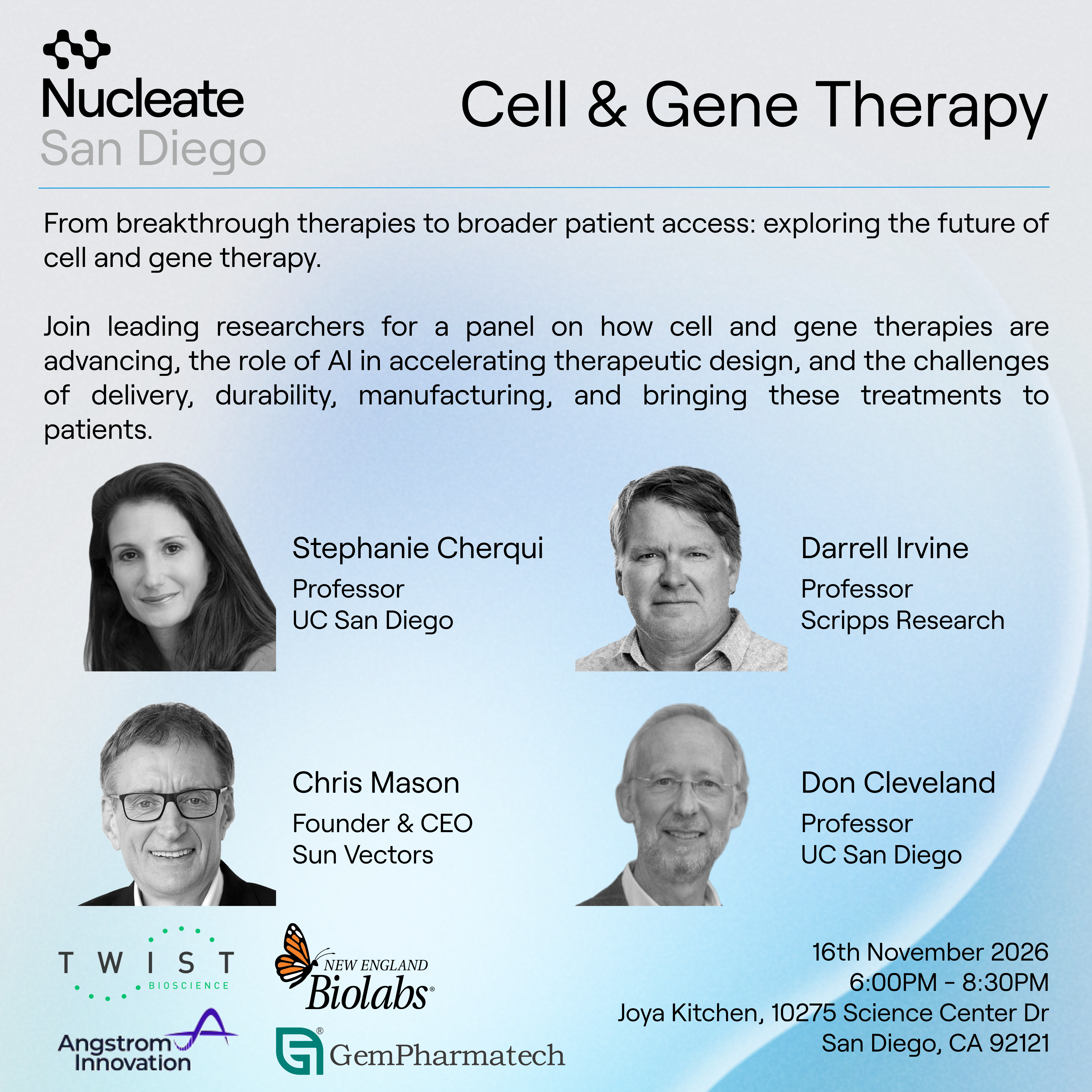
Nucleate San Diego Inside AIxBio Series: Cell and Gene Therapy
Downloads an .ics file · Times are in America/Los_Angeles · Google Calendar
Schedule: Registration and Networking: 5:30 pm - 6:20 pmPanel: 6:20 pm - 7:15 pmNetworking and refreshments: 7:15 pm and onwardsJoin Nucleate San Diego for Cell and Gene Therapy, a discussion on where the modality is delivering durable results, what still limits access, and how much of the design work that used to be trial and error is now being done computationally.
Cell and gene therapy has moved from a small number of approved products toward a wider pipeline spanning oncology, rare disease and autoimmunity. Delivery, durability and manufacturing remain the constraints that decide which programs reach patients and at what cost, and each of them is now being worked on with models as well as at the bench: capsid and promoter design, guide selection and off-target prediction, and process analytics that tell a manufacturing team what a batch is doing while it is still running.
This session works through what that changes and what it does not. Which design tasks are genuinely better handled by a model and which still need an experiment, how much data a company has to generate before any of it is useful to them, and how a predicted editing outcome is treated when it reaches a regulator. Alongside that, the questions that were already hard: manufacturing at scale, in vivo approaches, patient selection, long-term follow-up, and the economics of a treatment given once.
This event is part of the Nucleate Inside AIxBio Series, a chapter-wide program exploring the major avenues through which AI is influencing biotechnology, including drug discovery, lab automation, cell and gene therapy, and clinical translation, alongside the fundamentals of venture creation and building a biotechnology company.
Panelists:
Stephanie Cherqui, PhDStephanie Cherqui is a Professor of Pediatrics at UC San Diego School of Medicine, where she chairs the Cystinosis Stem Cell and Gene Therapy Consortium and co-directs the UC San Diego Gene Therapy Initiative, a program focused on rare genetic disease. Over more than a decade she developed an ex vivo approach to cystinosis that modifies a patient's own blood stem cells with a functional copy of the defective CTNS gene, taking it from her lab into a Phase I/II clinical trial whose first patient was treated in October 2019. The trial was the first to use gene-modified hematopoietic stem cell therapy for a multi-organ degenerative disorder where the missing protein sits in the lysosomal membrane rather than being a secreted enzyme. Her work is a strong example of academic translation in a disease area that large pharma was unlikely to fund because of limited commercial return, and she brings a grounded perspective on patient selection, long-term follow-up, and the economics of a one-time treatment.
Darrell Irvine, PhDDarrell Irvine is a Professor and Vice-Chair of the Department of Immunology and Microbiology at Scripps Research and a Howard Hughes Medical Institute Investigator, having joined Scripps from MIT, where he was a professor and earned his PhD. His lab engineers ways to direct and amplify immune responses, including work showing that a lymph node-targeting vaccine could boost CAR-T cells through their chimeric receptor, expanding tumor-killing T cells across several cancer types, including solid tumors where immunotherapy has struggled. A seasoned founder, he spun out Elicio Therapeutics in 2016 to bring his amphiphile vaccine platform to patients, and the company has reported promising Phase 1 data in pancreatic cancer. Irvine was recently named to the TIME100 Health list for his work empowering the immune system against HIV and cancer, and he brings a view on in vivo strategies for making cell therapies more durable and on what it takes to turn platform science into a company.
Chris Mason, MD, PhDChris Mason is the Founder and CEO of San Diego–based Sun Vectors and a clinician-scientist with over 30 years of cell and gene therapy experience spanning R&D, clinical medicine, manufacturing, and commercialization. He is a Full Professor of Cell and Gene Therapy in the Advanced Centre for Biochemical Engineering at University College London, with more than 250 publications and patents in the field. A serial entrepreneur, he was a Founder and former Chief Scientific Officer of AVROBIO and founded OriBiotech; both Sun Vectors and OriBiotech share a mission of enabling cell and gene therapy for everyone regardless of geography or financial resources. He also serves on the boards of several biotech companies and nonprofits, including Krystal Biotech, Papillon Therapeutics, and the Foundation for mRNA Medicines, was instrumental in founding the Alliance for Regenerative Medicine, and was elected a Fellow of the Academy of Medical Sciences in 2019. His experience across manufacturing, access, and company building makes him well placed to speak to what it will take to make these therapies affordable at scale.
Don Cleveland, PhDDon Cleveland is a professor at UC San Diego, where he has chaired the Department of Cellular and Molecular Medicine since 2008, and a member of the Ludwig Institute for Cancer Research. Gene therapy for neurodegenerative disease is a core focus of his lab, which works on CRISPR-Cas9 gene editing in the nervous system and on AAV9 for gene therapy in ALS and beyond. He and colleagues have used AAV for both gene silencing and gene replacement in the nervous system, showing broad delivery across the brain and spinal cord and developing an AAV-encoded short hairpin RNA aimed at the mutant SOD1 gene behind inherited ALS. With Ionis Pharmaceuticals, he also developed the first synthetic CRISPR RNA, an approach being developed to pair AAV gene delivery with synthetic CRISPR infusion for gene silencing or correction. His group showed that motor neuron death in inherited ALS requires damage to both motor neurons and their neighboring support cells, which pointed to replacing those non-neuronal cells with stem cells as a viable therapy. He is best known for pioneering the antisense gene-silencing approach that became tofersen (Qalsody), FDA-approved for ALS caused by SOD1 mutations, and he received the 2018 Breakthrough Prize in Life Sciences. He brings a perspective on one of the field's hardest delivery problems: reaching the brain and spinal cord with a one-time genetic therapy.
Sponsored by: New England Biolabs, Twist Bioscience, GemPharmatech, and Angstrom Innovation
About the Host:Nucleate is a 501(c)(3) nonprofit organization dedicated to empowering the next generation of biotech leaders. With chapters spanning 41 geographic regions and participation from over 280 academic institutions, Nucleate sparks new intellectual communities and embeds emerging talent within a global biotech community. Through open-access educational programming, Nucleate helps democratize biotech innovation — removing barriers and helping founders concentrate on building transformational technologies.
Visit www.nucleate.org for more information, and visit https://nucleate.org/privacy-policy/ to read our privacy policy.
We want to thank our HQ supporters for championing our open-access mission and empowering the next generation of biotech entrepreneurs!
Platinum: Eli Lilly and Company, Genentech, Alnylam Pharmaceuticals, MilliporeSigmaPhilanthropic Support: Lyda Hill PhilanthropiesPreferred Partners: Pillar VC, Amino Collective, Excedr, Mercury, Brex, Fedsprout, Browne ConsultingIn-Kind Support: AcademicLabs, Lens.org, SynBioBeta
More like this near Del Mar


Going to Nucleate San Diego Inside AIxBio Series? Ask me anything about it.
I read the organiser's pages and answer in a few seconds.
Answers are AI-generated · Privacy