

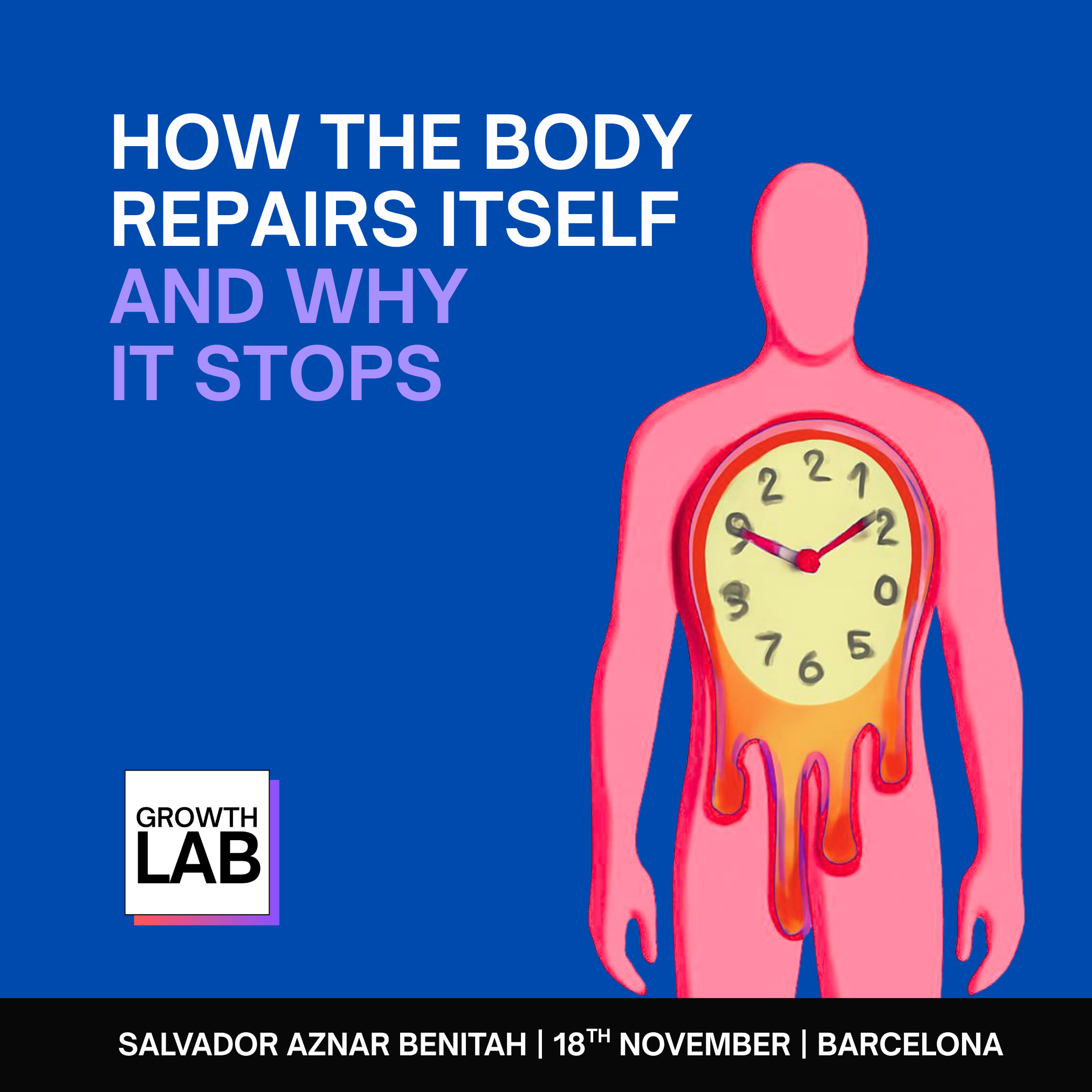
How the Body Repairs Itself, and Why It Stops
Downloads an .ics file · Times are in Europe/Madrid · Google Calendar
Your skin at sixty is not your skin at thirty, and the difference is not just accumulated damage but a scheduling failure. Can something as small as changing your routine help fix that?
The tissues that repair and regenerate you rely on a daily conversation between your brain and the clocks inside your muscle and skin cells, telling them when to divide, when to rest and when to rebuild. Break that conversation and the tissue starts ageing faster, even when everything else about it is healthy. That breakdown is not random. It's what happens when you eat at 1am, work nights for a year, or spend your days in artificial light with no strong signal telling your body what time it is.
In this Growth Lab LIVE session with Salvador Aznar Benitah, ICREA Research Professor and head of the Stem Cells and Cancer laboratory at IRB Barcelona, we go inside the stem cell to see how it decides when to divide and when to repair, and why that same machinery sits at the crossroads of agiing, metabolism and cancer.
Recent work from Salvador's lab, published simultaneously in Science and Cell Stem Cell, showed that peripheral clocks are surprisingly autonomous, handling roughly 15% of their circadian functions alone. But that 15% is basic housekeeping. Everything that actually protects a tissue from premature ageing requires the brain and the periphery in sync. It is a talk about time as a biological variable rather than a scheduling one, and about which lifestyle choices genuinely move the needle versus which ones just sound good on a podcast.
What you'll learn
Why tissue ageing is partly a coordination problem, not just a damage problem
How circadian disruption connects to ageing, metabolic disease and cancer risk, and where the evidence is strong versus still emerging
What the research actually supports when it comes to meal timing, light exposure and shift work, separated from the wellness noise
How a lab moves from a finding in stem cell biology to a possible therapy for age related decline
About the Speaker
Salvador Aznar Benitah is an ICREA Research Professor and head of the Stem Cells and Cancer laboratory at IRB Barcelona. His work on circadian rhythms, stem cell ageing and metastasis has been published in Nature, Science and Cell Stem Cell, and he is one of the most recognised voices in Spain on the biology of ageing.
Agenda:
1845h - Doors open
1900h - Talk starts
1945h - Q&A
2015h - Drinks & NetworkingGrowth Lab: Unlock Your Potential
Join us at Growth Lab, where ambitious minds gather to explore ideas that fuel personal and professional growth. Each session dives into powerful strategies and insights across psychology, philosophy, longevity, economics, and cutting-edge tech — designed to help you unlock your best self.
Expect thought-provoking talks, interactive discussions, and a community of like-minded individuals dedicated to bettering themselves. Whether you're seeking inspiration, new skills, or meaningful connections, Growth Lab is your space to grow.
Follow us on Instagram: @GrowthlabliveApply to Speak HEREApply to Sponsor HERE
More like this near Barcelona

Going to How the Body Repairs Itself, and Why It Stops? Ask me anything about it.
I read the organiser's pages and answer in a few seconds.
Answers are AI-generated · Privacy