

At the Crossroads: Dunhuang and its Global Connections International Conference
Downloads an .ics file · Times are in Asia/Singapore · Google Calendar
At the Crossroads: Dunhuang and its Global Connections
International Conference
8-10 January 2027
Ngee Ann Auditorium
Asian Civilisations Museum
10am to 6pm
Tickets
$20 (single-day) | $50 (three-days)
This three-day conference brings together over 40 leading scholars from around the world to explore Dunhuang and the Mogao Caves as a crossroads of artistic, religious, and cultural exchange. Drawing on art history, archaeology, conservation science, curatorial practice, and other disciplines, speakers will offer new perspectives on Dunhuang’s connections with the wider world.
Day 1 (Friday, 8 January)
Opening Keynote
The Devil is in the Detail: Character, Cosmopolitanism, and Conservation in the Mogao Cave Temples
Susan Whitfield
Professor in Silk Road Studies, Sainsbury Institute for the Study of Japanese Arts and Culture (SISJAC), University of East Anglia
Panels
Panel 1: Circulations and Transformations on the Silk Roads
This panel traces talismans, travelling monks, sacred architecture, and textiles across the Silk Roads. It shows Dunhuang as a vital node in a connected world.
"Dunhuang and Beyond: Talismanic Objects in the Pan-Asian Buddhist World" by Zhai Minhao (Assistant Professor of Global China Studies, NYU Shanghai)
"From Stūpa to Cave: Encountering the Buddha's Presence at Mogao Cave 254" by Dessie Vendova (Associate Lecturer, University of Massachusetts, Boston)
"The Impact of Indian Buddhist Monks on Dunhuang Buddhist Art during the Tenth and Eleventh Centuries" by Clara Ma (Jane Chace Carroll Associate Curator of Asian Art, Smith College Museum of Art
"From Dunhuang to the Mongol World (13th–14th century): Gold-Brocaded Textiles and Eurasian Visual Networks" by Yu Ruibo (Université Paris 1 Panthéon-Sorbonne)
Panel 2: Dunhuang and Beyond: Contexualising Buddhist Cave Temples
Exploring the Mogao Caves alongside other grottoes including Kucha, Turfan, and Maijishan, this panel examines the practices and traditions that shaped the visual and spatial worlds of Silk Road Buddhism.
"Re-thinking Early Dunhuang–Kucha Artistic Connections" by Monika Zin (Saxon Academy of Sciences and Humanities, Leipzig)
"Reconsidering the Donor Portraits in Mogao Cave 285: A Comparative Study with the Murals of Buddhist Cave Monasteries in Kucha during the Pax Hephthalica" by Satomi Hiyama (Assistant Professor, Department for Eastern Philosophy and Culture, Faculty of Letters, Toyo University)
"Representing Heaven in Dunhuang before the Caves: Art and Space of the Foyemiaowan Tombs" by Wu Dongming (Assistant Professor, Department of History, University of Macau)
"Sculpture, Devotion, and the Longue Durée of a Buddhist Cave Shrine" by Michelle C. Wang (Associate Professor, Department of Art and Art History, Georgetown University)
Panel 3: Conserving the Caves
Conservation scientists and specialists present case studies on protecting the Dunhuang caves, from in-depth object studies and material analysis to risk monitoring systems.
"Scientific and Technological Conservation and Digital Inheritance of Dunhuang Murals" 敦煌壁画科技保护与数字化传承 by Su Bomin (Former Director, Dunhuang Academy)
"Selective Adoption, Local Innovation: A Technical Framework for Dunhuang's Buddhist Clay-Based Sculptures" by Birgit Angelika Schmidt (Independent Researcher, Museum für Asiatische Kunst Berlin)
"Reconstructing the Biography of a Dunhuang Bodhisattva: Provenance Research and Scientific Analysis of a Sculpture from the Ōtani Expeditions" by Genichiro Katsuki (Special Senior Fellow, Tokyo National Museum; Professor, Daito Bunka University)
"Research and Practice on Systematic Conservation of Cultural Heritage: A Case Study of the Dunhuang Grottoes Monitoring and Early Warning Platform" 文化遗产系统性保护的研究及实践——以敦煌石窟监测预警平台为例 by Wang Xiaowei (Senior Research Fellow and Director of Dunhuang Grottoes Monitoring Center, Dunhuang Academy)
Day 2 (Saturday, 9 Jan)
Panels
Panel 4: Ritual and Worship
Scholars draw on manuscripts, murals, and ritual texts to examine the lived religious practices of Buddhist communities in Dunhuang and beyond.
"The Vegetarian's Dilemma: On the Prohibition of Certain Vegetables in Chinese Buddhism Based on the Wuxin jing 五辛經 [BD 06951] and Other Dunhuang Manuscripts" by James Robson (James C. Kralik and Yunli Lou Professor of East Asian Languages and Civilizations, Harvard University)
"Beyond the Altar Diagram: Picturing Ritual-in-Process at Dunhuang" by Fan Huajie (PhD Candidate, University of Virginia)
"Catalogues, Rituals, and Sūtra Worship: A Preliminary Study of the Falun Baochan (《法輪寶懺》) by Zhi Guan(咫觀)" by Feng Guodong (Professor, School of Literature, Zhejiang University)
"The Ascetic Transformed: The Fasting Buddha and the Adapting of a Meditation Tradition at Dunhuang" by Zhao Jinchao (Assistant Professor of Art History, Tongji University)
Panel 5: Multicultural Dunhuang
This panel explores the diverse peoples and religious traditions of Dunhuang, examining subjects ranging from Khotanese art in the caves to Tibetan ritual texts and Chinese Christian writings.
"Further Reflections on 'Khotanese Imagery' in the Dunhuang Caves" by Erika Forte (Professor, Kyoto University Institute for Research in Humanities)
"Translating across Religious Traditions: Jingjiao Texts from Dunhuang and the Making of Christian Discourse in Tang China" by Rong Huang (Assistant Professor of Asian Religions, Simon Fraser University)
"Tibetan-Language Ritual Literature from Dunhuang and a Globalized Buddhist World" by Lewis Doney (Professor of Tibetan Studies, Rheinische Friedrich-Wilhelms-Universität Bonn)
Panel 6: Text, Image, and Practice
How did Buddhist text, image, and practice shape one another? This panel explores how teachings were transmitted, adapted, and expressed through different forms.
"Scriptures, Images, and Banners: Postmortem Rituals Interpreted through Buddhist Texts Copied in Dunhuang" by Chen Ruifeng (Research Assistant Professor, School of Literature, Zhejiang University)
"The Holy Monk Liu Sahe 刘萨诃 and the Early Medieval Shanhu 山胡 Military Group" by Wei Bin (Professor, School of History, Wuhan University)
"Visualizing the Spirit Consciousness: Light, Performance, and Transformation in the Medicine Buddha Tableau of Mogao Cave 220 (642 CE)" by Xueyang (April) Peng (PhD Candidate, Harvard University)
Roundtable
Global Curating of the Silk Roads
Curators from institutions around the world discuss how they present the Silk Roads to audiences today.
Louise Lui (Curator, Chinese Art, Asian Civilisations Museum)
Luk Yu-Ping (Basil Gray Curator: Chinese Paintings, Prints and Central Asian Collections, British Museum)
Melodie Doumy (Curator, Chinese Collection, British Library)
Romain Lefebvre (Curator of Chinese, Japanese and Korean Collections, Bibliothèque nationale de France)
Yasuko Fukuyama (Professor, Faculty of International Studies at Ryukoku University and Director, Ryukoku Museum)
Day 3 (Sunday, 10 January)
Panels
Panel 7: Intermedial and Intercultural Patterns
The art of Dunhuang reflects centuries of encounter and exchange across cultures and materials. Speakers explore its connections to southern Chinese sericulture paintings, nomadic horse covers, and symbols of Iranian and Central Asian kingship.
““Fuxi (伏羲) and Nüwa (女娲) Guarding the Lotus Jewel: An Icon of Cross-cultural Exchange” 伏羲、女娲守护莲华摩尼宝珠 - 多元文明交融的图像范本 by Zhang Yuanlin (Deputy Director and Research Curator, Dunhuang Academy)
"From Dunhuang to Jiangnan: The Visual Transmission of the Silkworm Deity: A Case Study of S.5639 and the Cheng Qi Manuscript of Tilling and Weaving" by Bai Bing (Heidelberg University)
"To Defeat Evil: Boar and Bird Textile Motifs in Dunhuang and Other Buddhist Caves" by Mariachiara Gasparini (Associate Professor of Chinese Art and Architectural History, University of Oregon)
"Dunhuang Depictions of Khotanese Kingship and the Gifting of Royal Glory" by Neil Schmid (Research Professor, Dunhuang Academy)
Panel 8: Archiving Dunhuang
This panel explores how photography, publishing, and digital technologies are changing the way we access, interpret, and reimagine Dunhuang.
"The Power of Photography: The Lo Archive" by Dora C. Y. Ching (Executive Director, P.Y. and Kinmay W. Tang Center for East Asian Art, Princeton University)
"From Dispersal to Re-aggregation: Publishing as Virtual Repatriation and the Reframing of Dunhuang Library Cave Collections in 21st-Century China" by Xu Hanyin (PhD Candidate, Universiti Malaya)
"The Digital Reassembly of Dunhuang: Dispersed Collections, Curatorial Mediation, and Public Interpretation" 敦煌的数字重组——流散收藏、策展中介与公众阐释 by Liu Fang (Exhibition Center, Dunhuang Academy)
Panel 9: Dunhuang in the 20th Century: Artists and National Identity
The upheavals of the 20th century and the “rediscovery” of the Mogao Caves brought new attention to Dunhuang. They inspired generations of artists and prompted fresh reflections on shared heritage and identity.
"Exhibiting Dunhuang: Socialist Internationalism and the 1957 Tour in Poland and Czechoslovakia" by Liu Shasha (Postdoctoral Instructor, Department of Art History, University of Chicago)
"Refugee Artists at Dunhuang and National Salvation through Historical Preservation" by Amanda Wangwright (Associate Professor of Art History, University of South Carolina)
"Making Chinese Dunhuang: Exhibitions of National Cultural Heritage from the Borderland in Wartime China" by Guo Feng (Lecturer, Department of Literature and Cultural Studies, Education University of Hong Kong)
"Translating Dunhuang: Kim Lim, Printmaking, and the Transregional Logic of Modern Abstraction" by Jessica Braum (PhD Candidate, Temple University)
Closing Keynote
Religious and Social Diversity in Early Dunhuang Manuscripts
Stephen Teiser
D. T. Suzuki Professor in Buddhist Studies and Professor of Religion, Emeritus, Princeton University
The full programme, including the updated list of speakers and session details, will be announced on our website and social media channels. Tickets include lunch and tea breaks.
This conference is organised by ACM in partnership with the Dunhuang Academy, Asia Research Institute, Courtauld Institute, Dunhuang Foundation, and Harvard-Yenching Institute.
The museum reserves the right to make changes and modifications to the programme (including presentation titles and speakers) without prior notice. The views and opinions expressed by speakers do not represent the position of the Asian Civilisations Museum.
By attending this event, you consent to being video-recorded or photographed by ACM and its appointed photographers and to having such recordings/photographs used by ACM for marketing, publicity or promotional purposes.
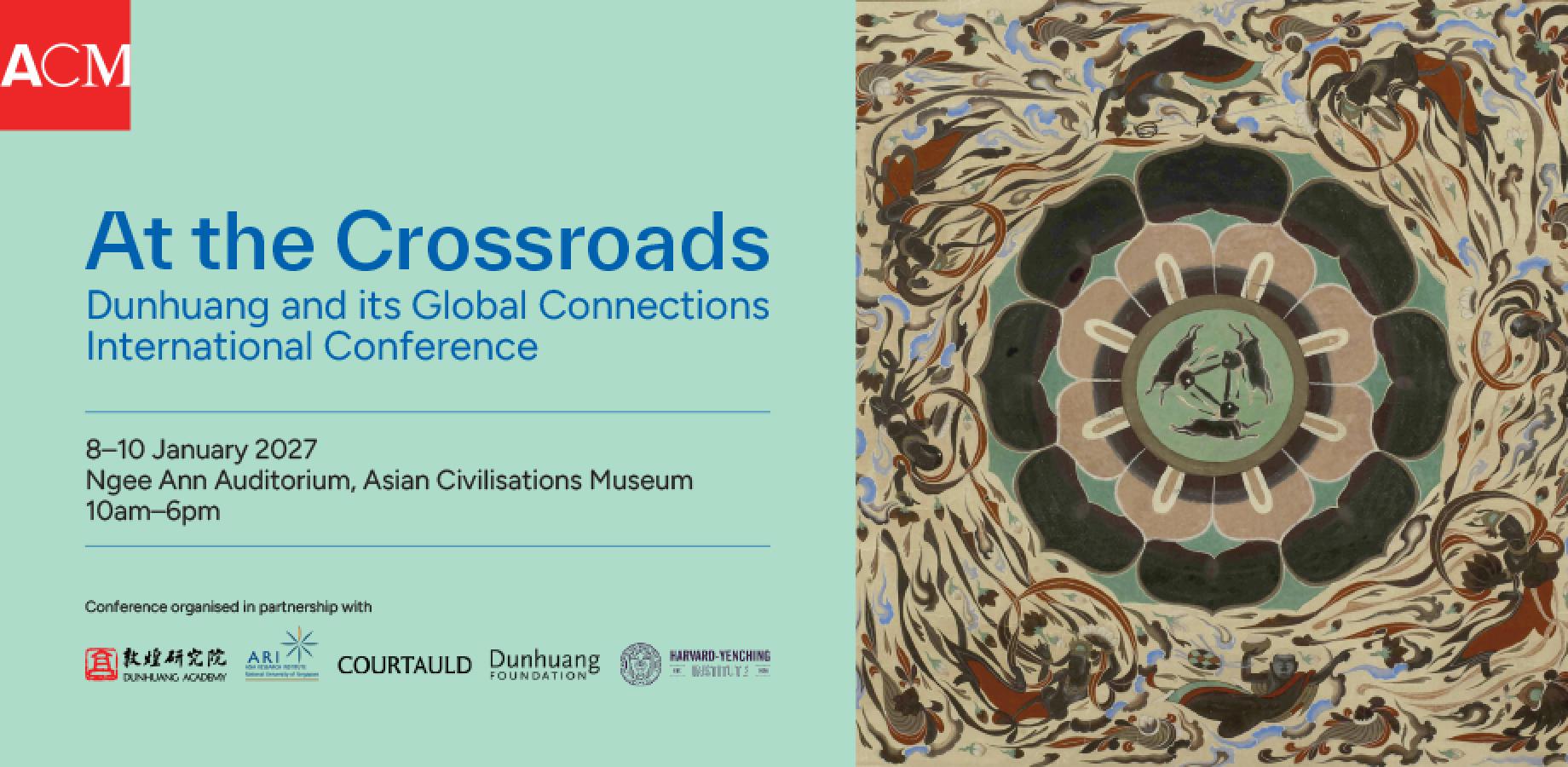
Image in banner: Ceiling with three hares, Cave 407, Sui dynasty (581–618), Duan Wenjie and Li Fu, 1954, Pigment on paper, L01992. Image courtesy of the Dunhuang Academy.
FAQ
1) What is included in my ticket?
Each ticket includes full access to the day's conference programme, covering all keynote addresses and panel discussions in that day, as well as a morning tea break, lunch, and an afternoon tea break.
2) Do I need to register at the event on all 3 days?
Yes, please sign in at the registration desk upon arrival each day.
3) Where is the meeting point and what time should I be there?
The conference takes place at the Ngee Ann Auditorium, located on the basement level of the Asian Civilisations Museum. The conference begins at 10am each day, and we recommend arriving at least 10 minutes early to allow time for registration. Please note that walk-ins without prior registration may be denied entry if spaces are full.
4) Is there an admission fee?
Yes, tickets are available at $20 per day, or $50 for a three-day pass covering all three days of the conference.
5) What language will the conference be conducted in?
The conference will be conducted primarily in English. A small number of presentations will be delivered in Mandarin, with simultaneous English translation available for those sessions.
6) What if the auditorium is at full capacity?
Due to high demand, we may open an additional breakout space, the River Room, where the conference panels will be livestreamed for attendees. Please note that all ticket holders will have full access to the conference programme and accompanying meals, regardless of seating location, and tickets are priced the same. Seating in the Ngee Ann Auditorium is on a first-come, first-served basis, so we encourage you to arrive early.
7) What should I do if I can no longer attend?
Please inform us as soon as possible via Peatix or through the conference email. Tickets may be refunded in full if we are notified at least 24 hours in advance.
8) Visiting the exhibition
The exhibition, Sacred Caves: Dunhuang, Buddhism, and the Silk Road, is now on view at the Asian Civilisations Museum till 7 March 2027. Visiting hours are from 10am to 7pm, and till 9pm on Fridays.
9) Further enquiries
We’d be happy to answer them for you! Drop us a note via Peatix.
More like this near Singapore


Going to At the Crossroads? Ask me anything about it.
I read the organiser's pages and answer in a few seconds.
Answers are AI-generated · Privacy