

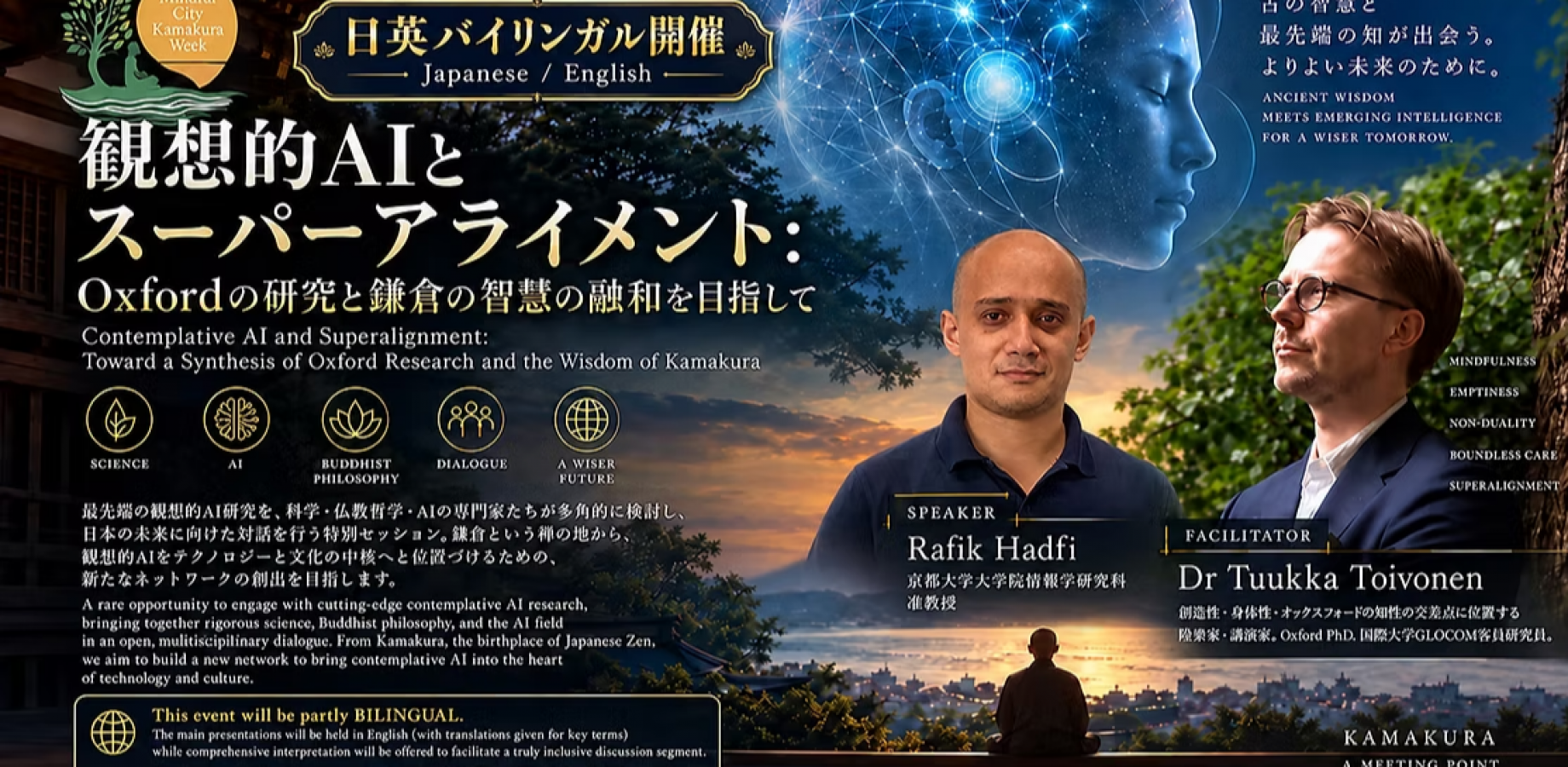
観想的AIとスーパーアライメント:Oxfordの研究と鎌倉の智慧の融和を目指して/Contemplative AI and Superalignment: Fusion of Oxford Research and Kamakura
Downloads an .ics file · Times are in Asia/Tokyo · Google Calendar
【日本語】
観想的AIとスーパーアライメント
本セッションは、最先端の「観想的AI(Contemplative AI)」研究に直接触れる機会です。厳密な科学、仏教哲学、AI研究を開かれた対話の場へと導き、観想的な叡智とテクノロジーの交差点を探ります。
中心となるのは、オックスフォード大学「Flourishing Intelligence Programme」ディレクターで、観想的AIとスーパーアライメントの研究を進めるルーベン・ラウッコネン博士(Dr Ruben Laukkonen)の研究です。本セッションは同博士の助言と後押しを得て企画されました。
ルーベン・ラウッコネン博士による紹介動画はこちら
鎌倉は日本禅の発祥の地であり、Zen2.0が10年にわたり育んできたテクノロジー、仏教をはじめとする観想的伝統、ビジネス、学術研究を横断するネットワークの拠点でもあります。
セッションの流れ
・導入:観想的AI研究の全体像
・レビュー:マインドフルネス、空/非執着、非二元、無量心などの主要概念、ブレイクスルーと未解決課題を批判的に検討
・応答:AI研究者、人類学者、観想研究者など多分野の専門家が各自の視点から論点を検証
・全体対話:観想的AIが日本の未来に何を意味するか、分野を越えて議論
なぜ、いま観想的AIなのか
AIの能力が加速度的に向上するなか、スーパーアライメントの重要性は高まっています。観想的AI研究をテクノロジーと文化の中核へ移すことが、賢明で安全なアライメントへの道筋になり得ると提案します。鎌倉を拠点に、日本で初となる観想的AIの分野横断ネットワークを立ち上げることも目指しています。Zen2.0 10周年本大会の前夜に開かれるため、参加者は鎌倉に滞在して関係を深め、翌日の本大会へとつなげられます。
キュレーター:トゥーッカ・トイヴォネン博士(Tuukka Toivonen, PhD / Oxford)
創造性、身体性、ホリスティック知性の交差点で活動する執筆家・講演家。国際大学GLOCOM客員研究員。ロンドンを拠点とするBecoming Regenerative Lab(Loughborough University London/Royal College of Art/UCL)の創設ディレクターで、同ラボはUKRIから100万ポンドの資金提供を受けています。オックスフォード大学、UCL、セントラル・セント・マーチンズ、京都大学、東京大学などで学術職を歴任し、研究成果はAcademy of Management Journal、Stanford Social Innovation Review、Routledgeなどから発表されています。
登壇者:Rafik Hadfi(京都大学大学院情報学研究科 准教授)
人々の議論・熟議・交渉・投票を支援するAIエージェントを10年以上開発。合意形成AIの研究が評価され、2026年度文部科学大臣表彰 科学技術賞を受賞。近年は人間らしい性格特性を持つAIエージェントの社会的・経済的行動を研究しています。日本学術振興会(JSPS)助成の「人間中心の自律性」プロジェクトを率い、AIエージェントが人々の自律性に与える影響と倫理的課題を検討しています。
開催概要
日時:2026年11月20日(金)13:00〜15:30
受付開始:12:40
会場:光明寺(神奈川県鎌倉市材木座6丁目
申込・参加費のお支払い:zenschool公式ページをご確認ください。
公式イベントページ:https://www.zenschool.jp/event-details/kansotekiaitosupaaraimento-oxfordnokenkyutokamakuranochienoyuwawomezashite-contemplative-ai-and-superalignment-fusion-of
言語:日英バイリンガル。主要な発表は英語。主要用語の訳出と議論パートの通訳あり。
主催:Tuukka Toivonen, PhD / Oxford 協力:株式会社enmono
会場について
天照山 蓮華院 光明寺は鎌倉・材木座の海に近く、由比ヶ浜を望む浄土宗の大本山です。鎌倉時代に開かれ、約800年にわたり祈りと内省の場として親しまれてきました。大きな山門、本堂、庭園、海風に包まれた境内で、立ち止まり呼吸を整え、自分自身へ還る時間をご一緒しましょう。
アクセス
JR横須賀線「鎌倉駅」東口から京急バス「小坪」「逗子・葉山方面」行きで「光明寺」下車すぐ。鎌倉駅東口から徒歩約25分。
ご参加にあたって
開催の約2週間前に重要な参考資料を配布します。セッションにより深く関わっていただくため、事前に目を通していただくことをおすすめします。
【English】
Contemplative AI and Superalignment
This session offers a rare opportunity to engage directly with cutting-edge research into Contemplative AI. It brings rigorous science, Buddhist philosophy and AI research into an open dialogue, exploring the intersection of contemplative wisdom and technology.
At its heart is the work of Dr Ruben Laukkonen, Director of the Flourishing Intelligence Programme at the University of Oxford and a pioneer in Contemplative AI and superalignment. The session has been organised with his guidance and support.
Kamakura, the birthplace of Japanese Zen, is also home to a network nurtured by Zen2.0 over the past decade, spanning technology, Buddhist and other contemplative traditions, business and academic research.
Session programme
・Introduction: an overview of contemplative AI research
・Review: a critical examination of mindfulness, emptiness / non-attachment, non-duality and boundless mind, including breakthroughs and unresolved questions
・Responses: experts in AI, anthropology and contemplative studies examine the issues from their perspectives
・Plenary discussion: a cross-disciplinary conversation on what contemplative AI means for Japan’s future
Why Contemplative AI now?
As AI capabilities improve at an accelerating pace, the importance of superalignment continues to grow. We propose that moving contemplative AI research from the periphery to the core of technology and culture may offer a path to wise and safe alignment. A further aim is to establish in Kamakura Japan’s first cross-disciplinary network centred on contemplative AI. Held on the eve of the Zen2.0 10th Anniversary Main Conference, the session also offers participants a chance to deepen connections in Kamakura and carry that momentum into the main conference the following day.
Curator: Dr Tuukka Toivonen (PhD / Oxford)
A writer and speaker working at the intersection of creativity, embodiment and holistic intelligence. Visiting Research Fellow at GLOCOM, International University of Japan. Founding Director of the London-based Becoming Regenerative Lab (Loughborough University London / Royal College of Art / UCL), which has received £1 million in funding from UKRI. He has held academic positions at Oxford, UCL, Central Saint Martins, Kyoto University and the University of Tokyo. His research has appeared in Academy of Management Journal, Stanford Social Innovation Review and Routledge publications.
Speaker: Rafik Hadfi (Associate Professor, Graduate School of Informatics, Kyoto University)
For more than a decade, he has developed AI agents that help people discuss, deliberate, negotiate and vote. His work on consensus-building AI agents received the 2026 Award for Science and Technology from Japan’s Ministry of Education, Culture, Sports, Science and Technology (MEXT). His recent work studies AI agents with human-like personality traits and their social and economic behaviour. He also leads a Japan Society for the Promotion of Science (JSPS)-funded project on human-centric autonomy, examining how AI agents affect human autonomy and the ethical questions this raises.
Event overview
Date and time: Friday, 20 November 2026, 13:00–15:30
Venue: Kōmyō-ji Temple (6-17-19 Zaimokuza, Kamakura, Kanagawa 248-0013, Japan)
Registration and payment: Please use the official zenschool event page. Peatix is for event discovery only; registration and ticket sales are not handled on Peatix.
Official event page: Open the official zenschool event page for details and registration
Language: Japanese and English. Main presentations are in English, with translations of key terms and interpretation during the discussion.
Organised by: Tuukka Toivonen, PhD / Oxford In collaboration with: enmono Co., Ltd.
Venue
Kōmyō-ji (Tenshōzan Rengein Kōmyō-ji) is a head temple of the Jōdo school of Buddhism near the shore of Zaimokuza, overlooking Yuigahama Beach. Founded in the Kamakura period, it has been a place of prayer and contemplation for nearly eight centuries. Its main gate, spacious hall, gardens and sea breeze create an unhurried setting for pausing, settling the breath and returning to oneself.
Access
From the East Exit of JR Kamakura Station, take the Keikyū bus bound for Kotsubo / Zushi-Hayama and get off at “Kōmyō-ji” (the temple is right by the stop). Alternatively, it is about a 25-minute walk from the station.
For participants
Key reference materials will be shared approximately two weeks before the event. We recommend reviewing them in advance to engage more deeply with the session.
More like this near Kamakura




Going to 観想的AIとスーパーアライメント:Oxfordの研究と鎌倉の智慧の融和を目指して/Conte? Ask me anything about it.
I read the organiser's pages and answer in a few seconds.
Answers are AI-generated · Privacy