

Galungan
Wednesday 13 January 2027
Start time not announced
Downloads an .ics file · All day · Google Calendar
Hey, how's it going? Galungan looks like it should be pretty interesting. Want me to help you organise around it?
Event details
Tickets sold by whatsonbali.com
Add to calendar · Downloads an .ics file · All day · Google Calendar
Galungan is one of the most important days in the Balinese Hindu calendar. It celebrates the victory of dharma (good) over adharma (evil) and marks the time when the spirits of deified ancestors are believed to return to the family home. Because it follows the 210-day pawukon cycle rather than the solar year, it usually falls twice every 12 months; the next Galungan is on Wednesday 13 January 2027.
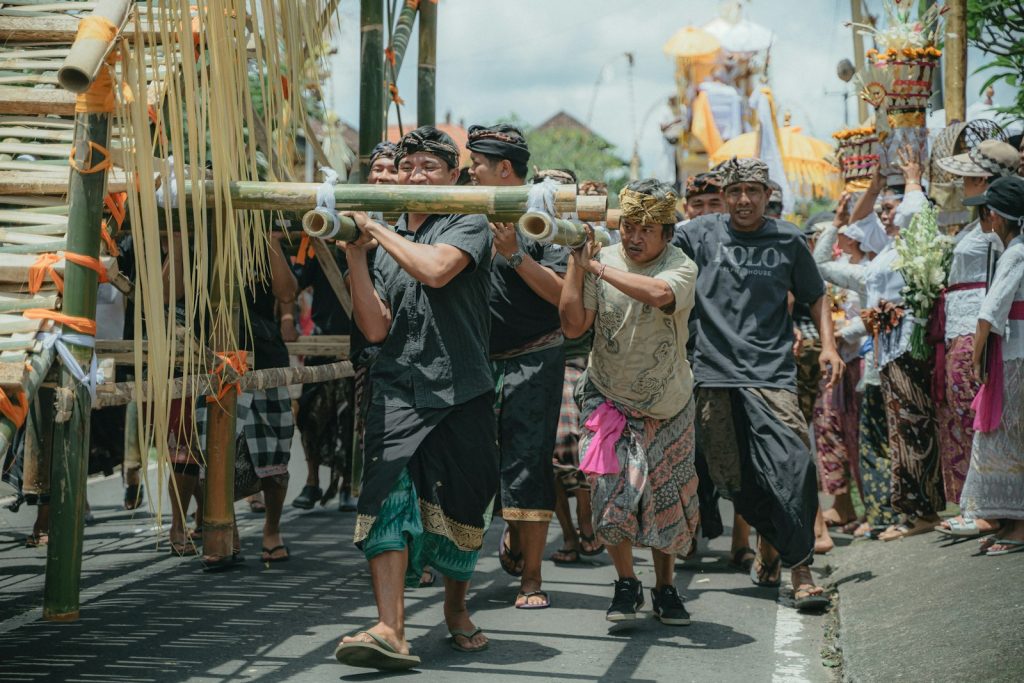
For visitors it is one of the most photogenic times to be on the island. In the days before, households raise penjor, tall, arching bamboo poles decorated with woven coconut leaves, fruit and rice, so that entire village roads become tunnels of swaying decorations.
About the event
The build-up begins days earlier: Penyekeban and Penyajaan are spent preparing offerings and cakes, and on Penampahan, the day before Galungan, pigs are slaughtered for ceremonial feasts such as lawar and babi guling. On Galungan itself families dress in white and ceremonial clothes and visit their family temple, village temples and relatives.
What to see
Penjor-lined streets, especially in Ubud, Penestanan, Mas and Sidemen
Processions of families carrying offering towers to temple
Barong dancers going door to door in some villages in the following days (ngelawang)
Etiquette & dress
Wear a sarong and sash and cover shoulders and knees if you enter a temple.
Never step on offerings (canang) on the ground, and do not walk in front of people who are praying.
Ask before photographing people in ceremonial dress, and keep a respectful distance from processions.
Women who are menstruating are traditionally asked not to enter temples.
Before you go
Some shops, warungs and family-run businesses close or shorten hours, and staff take leave to return to home villages, expect slower service and book tours in advance.
Main temples such as Besakih, Tirta Empul and Uluwatu become busy with worshippers; arrive early and give way to people praying.
Village areas like Ubud and Sidemen offer the most atmospheric streetscapes.
Traffic is heavier as families travel between villages.
Combine it with
The Galungan–Kuningan period is a good time to base yourself in Ubud and explore nearby villages by bicycle or with a driver: Penestanan and Sayan for penjor-lined lanes, the stone-carving village of Batubulan, or Tirta Empul in Tampaksiring, where worshippers queue to bathe in the holy springs. Evening dance performances at Ubud Palace and other stages continue during the festive period. If you are hiring a driver, ask them about their own family’s preparations, many Balinese are happy to explain what the offerings mean, and it makes the experience far richer than simply watching from the roadside.
Galungan opens a ten-day festive period that ends with Kuningan on Saturday 23 January 2027.
More like this near Ubud


Also on in Ubud
- Shichirin | UbudMon 2 Nov · Shichirin Ubud Japanese Restaurant by Wonderspace
- Habitat Bistro | UbudMon 2 Nov · Habitat Bistro Ubud Italian Restaurant Wonderspace
- Ankhusa | UbudMon 2 Nov · Ankhusa Ubud River Valley View Western & Asian Cuisine by Wonderspace
- Kojin | UbudMon 2 Nov · Kojin Japanese Restaurant Ubud by Wonderspace
- Monday Quiz Night Ubud — The Melting Pot Saloon | Free Entry, Every WeekTue 3 Nov · The Melting Pot Saloon
Going to Galungan? Ask me anything about it.
I read the organiser's pages and answer in a few seconds.
Answers are AI-generated · Privacy