

AI4Science - The Next Chapter for Science
Downloads an .ics file · Times are in Europe/Berlin · Google Calendar
Hey, how's it going? AI4Science - The Next Chapter for Science looks like it should be pretty interesting. Want me to help you organise around it?
Event details
Tickets sold by luma.com
Add to calendar · Downloads an .ics file · Times are in Europe/Berlin · Google Calendar
The year is 2026. AI drafts hypotheses, runs simulations and proposes candidate molecules faster than any scientist can check them. So what does a scientist do all day now?
Where do new ideas come from? Will AI widen what we imagine, or pull everyone toward the same safe answers? What counts as understanding when a model can predict what no one can explain? And as AI grows more capable and more autonomous, how do we keep it working toward what science is for: understanding, shared openly, in service of people?By 2036, “AI for science” may simply be called science. Whether that science is good, safe, and trustworthy depends on the work being done today.
This AI4Science evening brings together some of the researchers doing it, as the international science community gathers for Berlin Science Week. Our panelists divided into two panels take on the questions above from different corners of the field:
Program
18:00 - Welcome & drinks
18:30 - Panel | When AI Thinks: What’s Left for the Scientist?
19:15 - Panel | When AI Acts: Should We Just Let It Run?
20:15 - Networking & drinks
21:00 - See you next time!
About the speakers
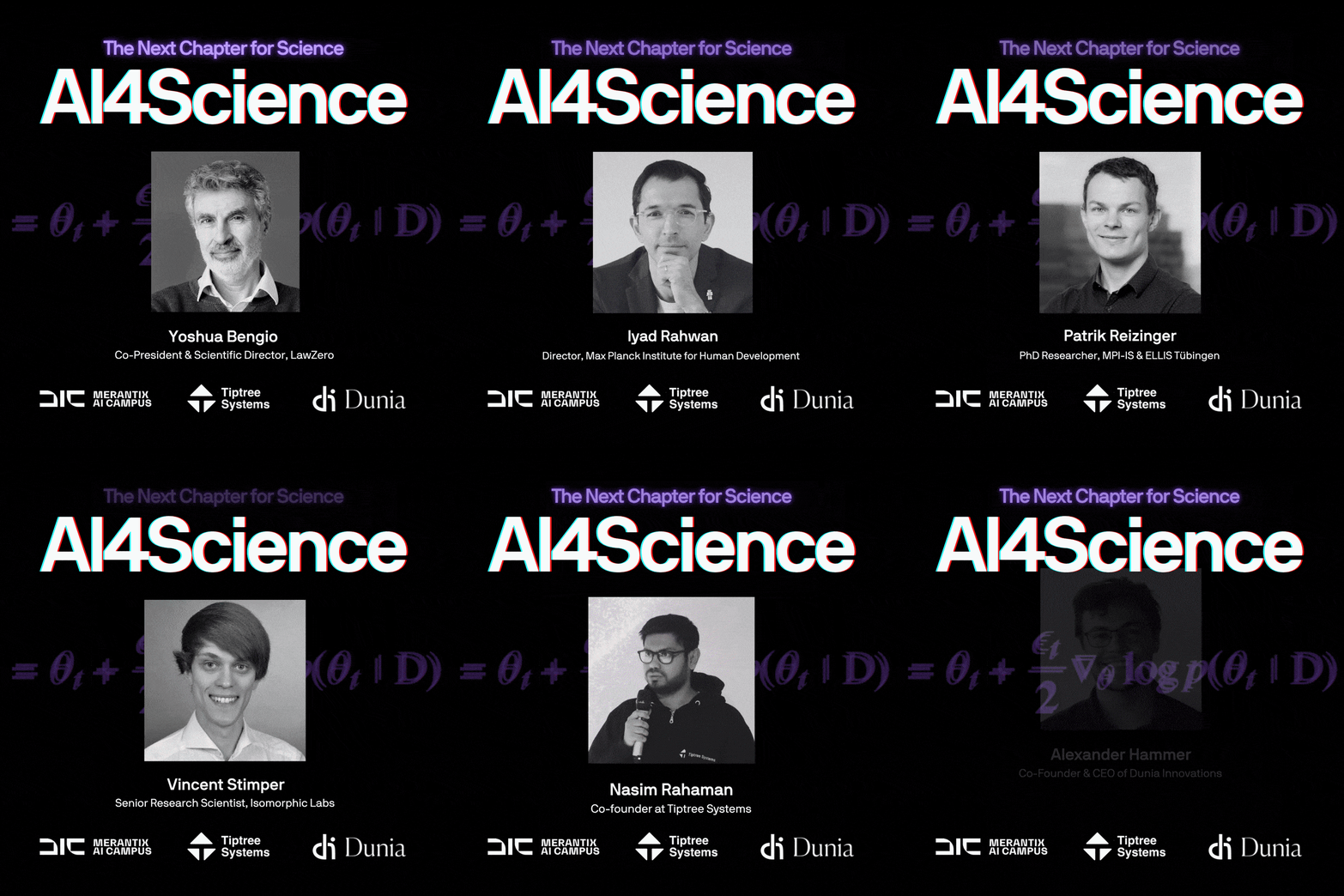
🎤 Yoshua BengioCo-President & Scientific Director, LawZeroTuring Award recipient (2018) for foundational work in deep learning, founder of Mila, and the most-cited computer scientist worldwide. Since 2023 he has focused on AI safety, and in 2025 he launched LawZero, a nonprofit building Scientist AI, an approach to highly capable AI that is safe by design. He also chairs the International AI Safety Report and holds a Canada CIFAR AI Chair.
🎤 Lyad RahwanDirector, Max Planck Institute for Human Development; Founder, Center for Humans and MachinesStudies how AI changes the way people think, learn, work, cooperate, and govern. He helped establish the field of machine behaviour, which studies AI systems as actors with behavioural patterns of their own, and led the Moral Machine experiment, which gathered tens of millions of decisions from people worldwide on the ethics of autonomous vehicles. Before moving to Berlin, he led the Scalable Cooperation group at the MIT Media Lab. He is also an honorary professor at TU Berlin.
🎤 Annalena KoflerPhD Candidate in Machine Learning, Max Planck Institute for Intelligent Systems (Tübingen)Works at the intersection of machine learning and physics in Bernhard Schölkopf’s Empirical Inference department, building deep generative models and simulation-based inference for problems that resist exact solutions, from gravitational-wave signals to particle collisions at the LHC. She studied physics at TU Munich and is an IMPRS-IS and ELLIS scholar, selected for the 2025 Lindau Nobel Laureate Meeting. Her work on normalizing flows for high-energy physics was done jointly with fellow panelist Vincent Stimper. She also cares about bringing research to wider audiences, with invited talks from UC Berkeley to public Soapbox Science events.
🎤 Patrik ReizingerIVADO Postdoctoral Fellow, Mila / Université de MontréalWorks on causal representation learning and on when and why models generalize, including out-of-distribution and compositional generalization. His research has taken him from a PhD in Tübingen through Cambridge and the Vector Institute to Mila. As a BiTS × SPRIND fellow, he is building automatic, graded verification for scientific claims, so that AI-assisted research can build on what is already well supported. He also writes about scientific taste, the skill of telling great ideas from bad ones, and why it matters more once AI does the producing.
🎤 Ksenia BrilingPostdoctorate Researcher, EPFLWorks where quantum chemistry meets machine learning, on the question of how to keep ML models of molecules grounded in physics rather than treating them as black boxes. In Clémence Corminboeuf’s group at EPFL she completed a PhD encoding quantum-chemical knowledge into ML, building molecular representations such as the SPAHM family and geometric deep-learning models for chemical reactions, so that predictions of properties like electron density stay physically meaningful. She took prizes at the last two AI4Science hackathons, and comes to the field from a background in fundamental chemistry at MSU.🎤 Vincent StimperSenior Research Scientist, Isomorphic LabsBuilds machine learning methods for the natural sciences at Alphabet’s AI drug-discovery company. He studied physics at TU Munich and completed his PhD at Cambridge and MPI-IS Tübingen, developing generative models of the shapes molecules can take. He is also the lead developer of widely used open-source implementations of these models.
🎤 Alexander HammerCo-founder & CEO, Dunia InnovationsAfter working in industrial R&D at BASF and Siemens, Alex did his PhD at the University of Glasgow with Lee Cronin, contributing to chemputation, the approach of turning chemistry into code that robots can run. In 2022 he co-founded Dunia to close the gap between what AI predicts and what actually works in the lab. Dunia’s self-driving lab, IRIS, couples AI with autonomous robotic experimentation to design, make and test new materials for catalysis, energy storage and semiconductors. In 2026 the company announced plans for a Berlin GigaLab to do this at industrial scale. He argues that the bottleneck in AI for science is not necessarily compute but rather trustworthy experimental data.🎤 Moderated by Nasim RahamanPhD with Yoshua Bengio and Bernhard Schölkopf, and co-founder at Tiptree Systems.
About your hosts
Merantix AI Campus: In the heart of Berlin, the Campus is home to 80+ AI teams and hosts 300+ events a year. Part of Merantix, driving Europe’s AI future since 2016, the Campus is where the brightest and most ambitious founders, operators, engineers, industry leaders, and investors come together to shape next-generation AI infrastructure and applications across industries.
Tiptree Systems is an AI company on a mission to accelerate science by reimagining how researchers and AI collaborate. Their AI scientific coordinator, Althea, routes knowledge and opportunities to the right people, so that breakthroughs don’t get left on the table.
Dunia Innovations is a Berlin-based deeptech startup using physics-informed AI and robotic automation to accelerate the discovery of advanced electrochemical materials. Their mission is to remove bottlenecks in scalable carbon utilization, enabling faster development of solutions like electrocatalysts for green hydrogen and CO₂ conversion.
More like this near Berlin

Also on in Berlin
- YFC Side Event: Founders RunSat 7 Nov · 8am · The Delta
- YFC Female Founders BreakfastSat 7 Nov · 8:15am · NLND Neuland Berlin
- YFC Side Event: VC BreakfastSat 7 Nov · 8:15am
- Art in the Wild · Adventure Hike · 20 kmSat 7 Nov · 9:05am · Charlottenburg
- Autumn Hike to Schloss Wiesenburg, Hagelberg Summit & Burg Eisenhardt 🍂🏰Sat 7 Nov · 9:10am
Going to AI4Science? Ask me anything about it.
I read the organiser's pages and answer in a few seconds.
Answers are AI-generated · Privacy